← the lab
The Lab · Edition № VI · an impossibility guide

Squaring
the Circle

Four masters, four constructions, one theorem that says all of them must fail. Twenty-three centuries of the most famous impossible problem — its history, its near-misses measured to the nanometer, and every compass move drawn live.

I · The problem of antiquity

The oldest impossible problem

The challenge fits in one sentence: given a circle, construct — with compass and unmarked straightedge alone — a square of exactly the same area. It sounds like homework. It became the longest-running open problem in the history of mathematics: posed in the fifth century BC, closed in AD 1882, and never once solved, because it cannot be solved. The Greeks suspected none of this. Anaxagoras worked on it in prison. Hippocrates of Chios squared little moon-slivers bounded by circular arcs — the famous lunes, the first curved regions ever converted exactly to straight-sided ones — and the partial success felt like a promise: if a lune, why not the whole disc?

The chase outlived antiquity. It survived Archimedes, who trapped π between 3 10⁄71 and 3 1⁄7 without ever claiming to square anything. It filled the medieval margins, minted the phrase squaring the circle as a synonym for futility, and by 1775 so many amateur "solutions" flooded the Paris Academy that it formally refused to examine any more of them — a full century before anyone had proved the thing impossible.

The end came in two blows. In 1761 Lambert proved π irrational — no fraction. In 1882 Ferdinand von Lindemann proved π transcendental — no polynomial equation with whole-number coefficients has π as a root, ever. And since every point a compass and straightedge can reach is algebraic, the true square's side, √π, lies permanently outside the reachable universe. Not undiscovered: unreachable.

What remains after 1882 is a museum of magnificent near-misses — and this page walks four of them, move by move, measuring exactly how close each one comes.
~450 BC

Anaxagoras

First recorded attempt — worked, says Plutarch, while imprisoned for impiety in Athens.

~440 BC

Hippocrates

Squares the lunes — curved regions made exactly straight. The great tease of Greek geometry.

~250 BC

Archimedes

Traps π between 3 10⁄71 and 3 1⁄7 with 96-sided polygons. Bounds, honestly — never a squaring.

1685

Kochański

The Jesuit clockmaker's one-compass-setting rectification: π to four decimals. Stepped below.

1761

Lambert

π is irrational — no fraction. The first crack in every exact-quadrature dream.

1882

Lindemann

π is transcendental. √π is unconstructible. Case closed, twenty-three centuries after opening.

1897

Indiana Pi Bill

A state legislature nearly legislates a circle-squarer's π. Passed the House 67–0; died in the Senate.

2026

This journal

The constructions drawn by hand in graphite and ink — photographed below, alongside the animated proofs.
II · Four voices

Each master, in his own words

Four approaches, four temperaments, four centuries. Each chapter below speaks the way its author taught — the Renaissance engineer, the baroque Jesuit, the self-taught genius, the modern mystic. The mathematics section afterwards puts the same four constructions under one ruler and measures them without sentiment. Both tellings are true; they simply serve different masters.

Leonardo da Vinci · c. 1504 · equal area

The wheel that measures itself

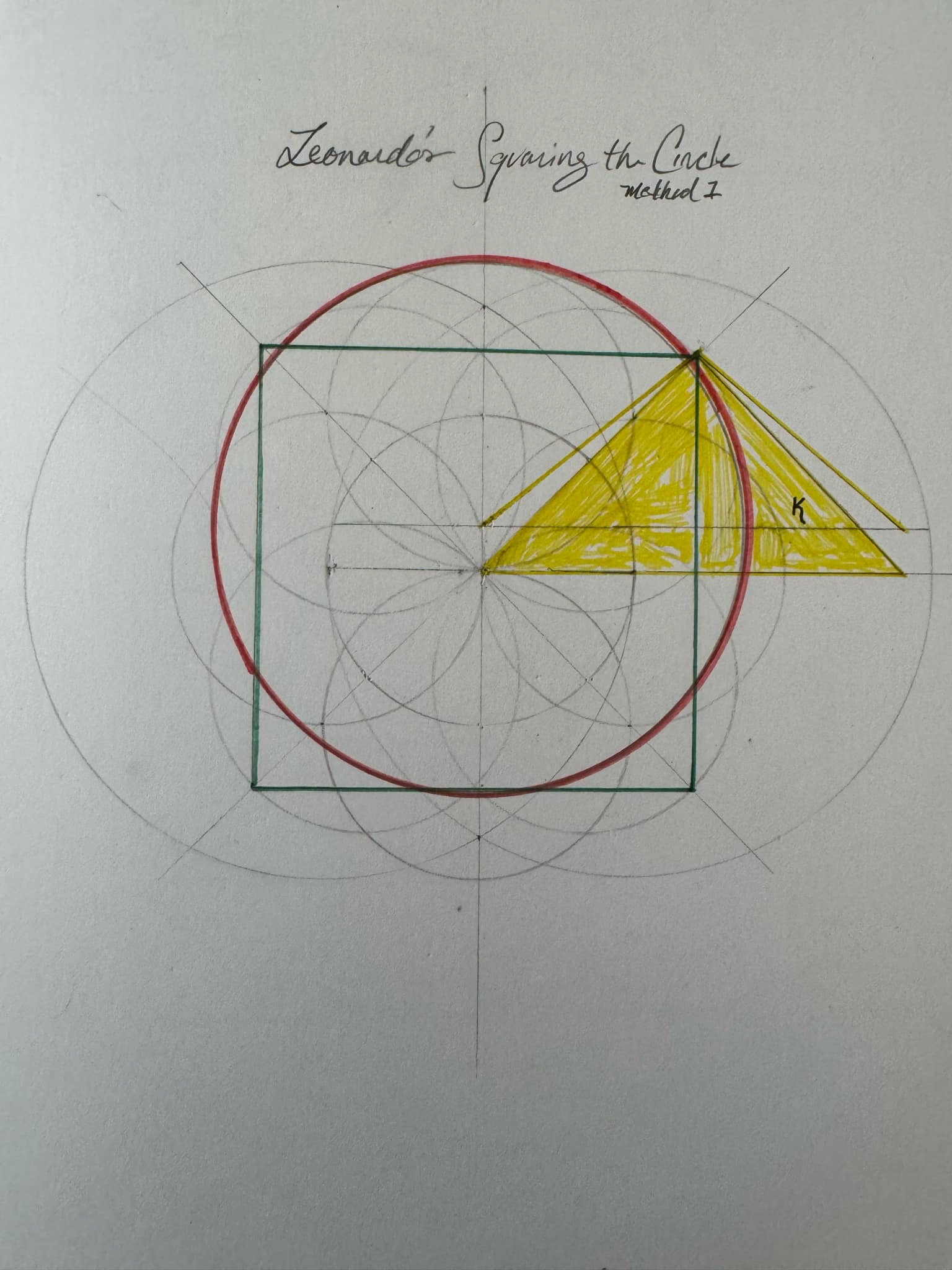
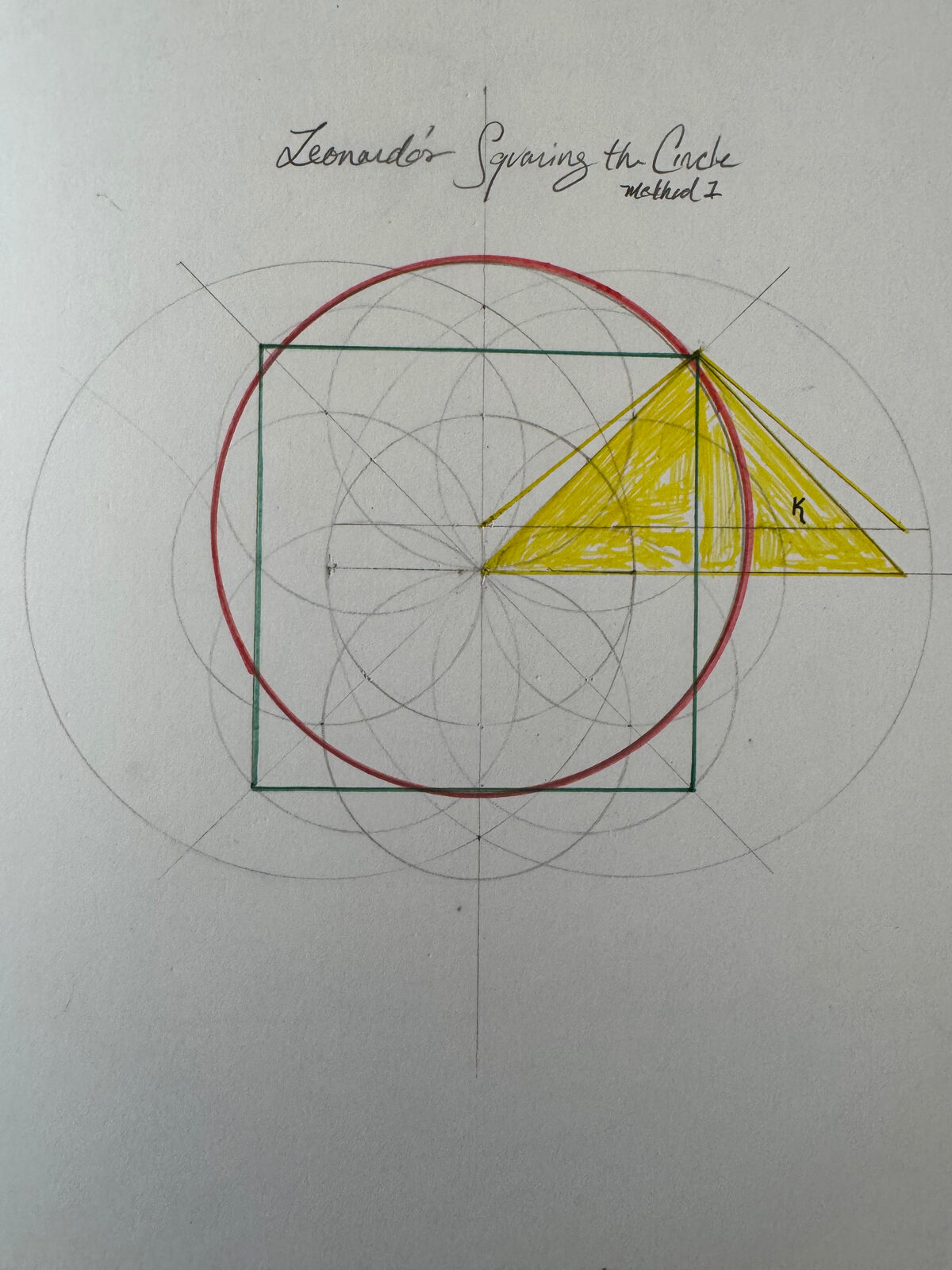
The night of Saint Andrew, he writes, he reached the end of squaring the circle — and the candle, the night, and the paper ran out together. Leonardo filled folio after folio of the Codex Atlanticus with quadrature studies, and his most disarming idea is a machine: take the circle to be a wheel, of thickness half its radius, and roll it one full turn upon the ground. The wheel prints its own circumference into the world — a rectangle equal to the circle — and one geometric mean later, the rectangle is a square.

The engineer's answer to a geometer's riddle: if the length cannot be constructed, let the object announce it by rolling.

Step the wheel, move by move →
Adam Adamandy Kochański · 1685 · equal area

A clockmaker's honest π

Librarian to the King of Poland, correspondent of Leibniz, builder of clocks — Kochański published his approximate rectification in the Acta Eruditorum, and the word approximate is in the title, set there proudly. One fixed compass opening, a 30-degree angle folded from pure symmetry, three radius-steps along a tangent line: the hypotenuse that results is √(40⁄3 − 2√3), which misses π only in the fifth decimal. In an age of brass instruments, that was better than any instrument could engrave.

He never claimed the impossible — he claimed four decimals, and delivered them with a single setting of the compass.

Step the 1685 construction →
Srinivasa Ramanujan · 1913 · equal area

355 over 113, drawn taut

A one-page note in the Journal of the Indian Mathematical Society, signed by a clerk from Madras the world had not yet heard of. No motivation is offered, and hardly any proof: bisect here, trisect there, a chord equal to that height, two parallels, a tangent, one final proportion — and the segment RD emerges bearing the length √(355⁄113), the square root of the best small fraction π has. Squared into area, it agrees with the circle to the seventh figure. He noted, deadpan, that on a circle the size of India the error would be about an inch.

Fully aware of Lindemann, he aimed not at possibility but at elegance — the tightest small-number ambush of π ever ruled on paper.

Step the 1913 construction →
Robert Edward Grant · 2018 · equal perimeter

π as a shadow of φ

In Grant's teaching, the circle and the square were never estranged — they are reconciled through the golden ratio. Cut the radius in golden section, take the height 1⁄√φ that a semicircle lifts over the reciprocal point, and the square built on twice that height has a perimeter equal to the circle's circumference — under the identity he places at the center of his cosmology: π = 4⁄√φ = 3.1446… For Grant this is not approximation but revelation: the circle of spirit and the square of matter sharing one measure, with φ as the mediator.

Presented here exactly as taught. What the identity implies — and what Lindemann says back — is measured plainly in the next section.

Step the golden construction →
III · The constructions

Every arc, every claim

Four constructions, one board. Pick a master; every elementary move — each compass arc, each ruled line, each point born from a crossing — plays out in order, with the geometry computed to machine precision underneath. The wheel badge marks the moves Euclid would refuse. Each method remembers where you left it.

Step 0

tip: step · 14 switch method
IV · The mathematics

The ruler over all four

Why must every one of these fail? Because a compass and straightedge can only solve quadratic equations. Each new point costs at most one square root, so everything constructible lives inside towers of nested square roots — algebraic numbers of a very particular, power-of-two degree. This is the same theorem that grants the heptadecagon (cos 2π⁄17 is exactly such a tower — see Edition № V) and it is the theorem that condemns quadrature. The two pages are the same law, read from its two sides.

Lindemann's 1882 theorem finishes it: starting from e = −1, he proved π satisfies no polynomial with rational coefficients at all. π is not merely outside the tower of square roots — it is outside algebra. Hence √π is unconstructible, hence no square with area πr² can ever be ruled from a circle. Everything after 1882 is either an approximation, a changed rule, or a changed claim:

√2 ✓φ ✓cos 2π⁄17 ✓∛2 ✗π ✗ — constructible numbers: degree must be a power of 2, and π has no degree at all
methodclaims equalimplied πrel. errorat r = 10 cm
Leonardo (the roll)areaπ exactly0 — but the roll isn't a compass move0
Kochańskiarea√(40⁄3−2√3) = 3.14153331.9 × 10⁻⁵side 1.7 µm short
Ramanujanarea355⁄113 = 3.14159298.5 × 10⁻⁸side 7.5 nm long
Grantperimeter4⁄√φ = 3.14460559.6 × 10⁻⁴side 151 µm long

A sharp pencil line is roughly 300–500 µm wide. Kochański's and Ramanujan's errors drown inside the graphite; Grant's is the only one on this page a careful hand could actually see.

The verdicts in full — Lindemann, and the golden π

What "constructible" means, precisely

Start from a unit length. Every straightedge line is a linear equation; every compass circle is quadratic. Intersecting them produces coordinates obtained from the old ones by +, −, ×, ÷ and square roots. So each constructible number is algebraic, of degree 2k over the rationals. That single sentence decides every classical problem at once: doubling the cube demands ∛2 (degree 3 — dead), trisecting the general angle demands a cubic (dead), the 17-gon demands degree 16 = 2⁴ (alive — Gauss), and squaring the circle demands √π.

Lindemann, in one paragraph

Hermite (1873) proved e transcendental. Lindemann (1882) extended the machinery: if α is a nonzero algebraic number, eα is transcendental. But e = −1, which is about as algebraic as a number can be. Therefore iπ — and with it π — cannot be algebraic. No polynomial, no degree, no tower, no construction. The Paris Academy had stopped reading quadrature manuscripts 107 years early, and turned out to be exactly right.

The golden π, audited

Grant's identity π = 4⁄√φ is beautiful — and checkable. Square it twice and clear denominators:

π = 4/√φ  ⟹  π² = 16/φ  ⟹  φ = 16/π²  and since φ² = φ+1:  π⁴ + 16π² − 256 = 0

That is a degree-4 polynomial with integer coefficients. If the identity held, π would be algebraic of degree four — precisely what Lindemann proved impossible. So the identity is necessarily approximate: 4⁄√φ = 3.14460…, which is π + 0.096%. The construction above is real and the square it draws is exact for the number it encodes; the number simply isn't π.

No square serves two masters

A subtlety the four claims expose: the equal-area square has side √π·r = 1.7725 r, while the equal-perimeter square has side π⁄2·r = 1.5708 r. These differ by 12%. Any "squared circle" must declare which it means — and Grant's, at side 1.5723 r, sits beside the perimeter target, 21% short on area. Leonardo, Kochański and Ramanujan all aim at area.

What the wheel is worth

Leonardo's roll is exact and inadmissible; the moderns made that trade honestly too. Allow a marked ruler, a rolling curve, or Archimedes' spiral, and quadrature is easy — antiquity already knew several such "mechanical" squarings. The 2,300-year drama was never about getting a square; it was about getting one inside Euclid's austere rules. That is the game Lindemann ended.

V · The journey — in graphite and ink

Chasing π by hand

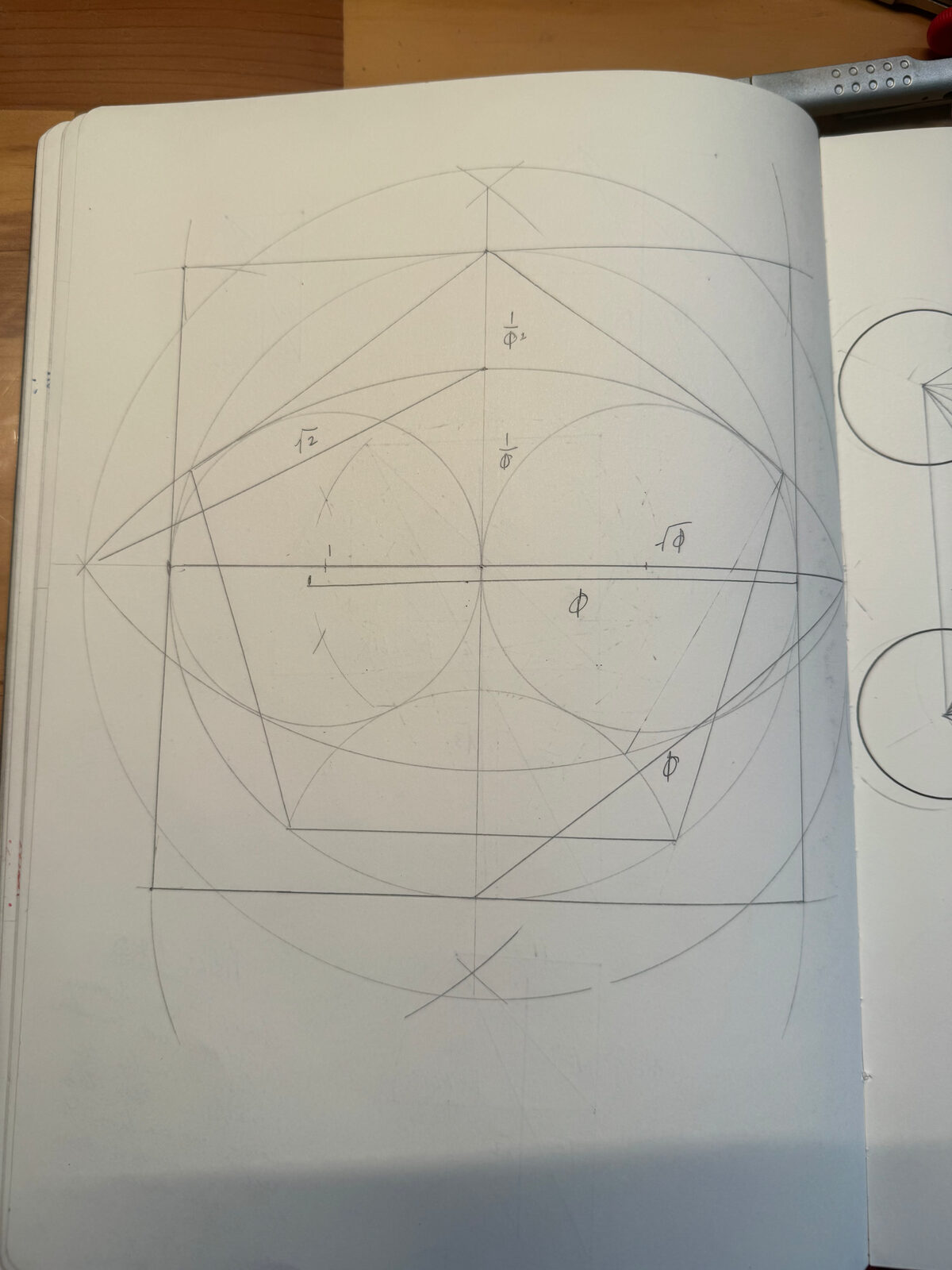
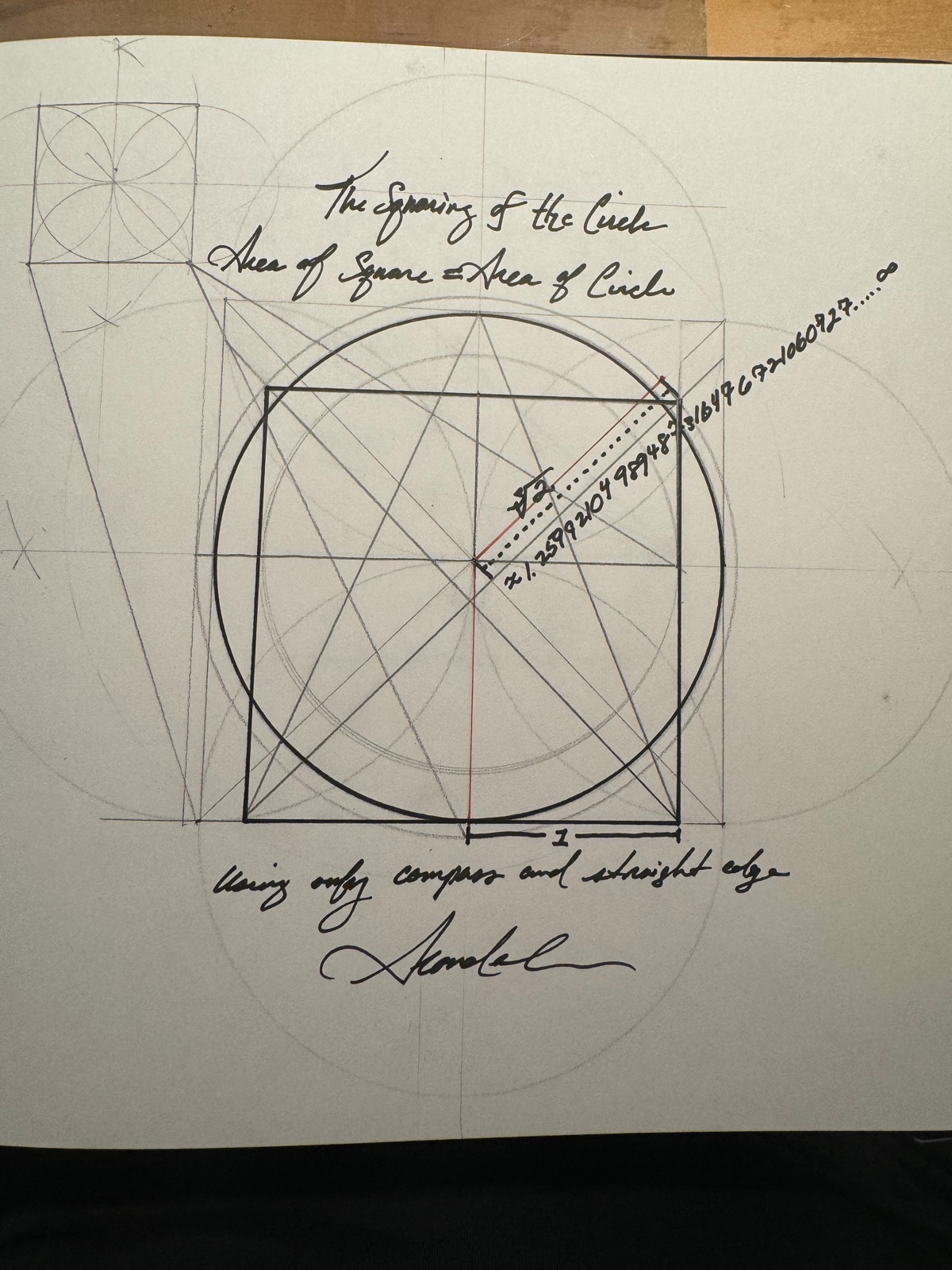
The drawings below are the origin of this page: quadrature worked in pencil in the journal — the golden-section scaffolding, the vesica, the pentagon, √2 and √φ labeled mid-flight — and Leonardo's rolling-wheel idea reconstructed the way he sketched it. On paper the impossibility is invisible; a 10⁻⁵ error hides comfortably inside a pencil line. That is exactly why the theorem, not the drawing, had to be the referee.

Pencil quadrature study — circle, square and pentagon scaffolding with golden-ratio segments labeled
Study · graphite

The golden scaffolding

Circle, square and pentagon sharing one armature — the φ segments measured out along the diameter, the construction feeling for the 4⁄√φ claim.

Study after Leonardo's quadrature — the rolled-out circle and rectangle in pencil
Study · after Leonardo

The wheel, reconstructed

Leonardo's rectification idea worked through in the journal — the circle become rectangle, the rectangle en route to a square.

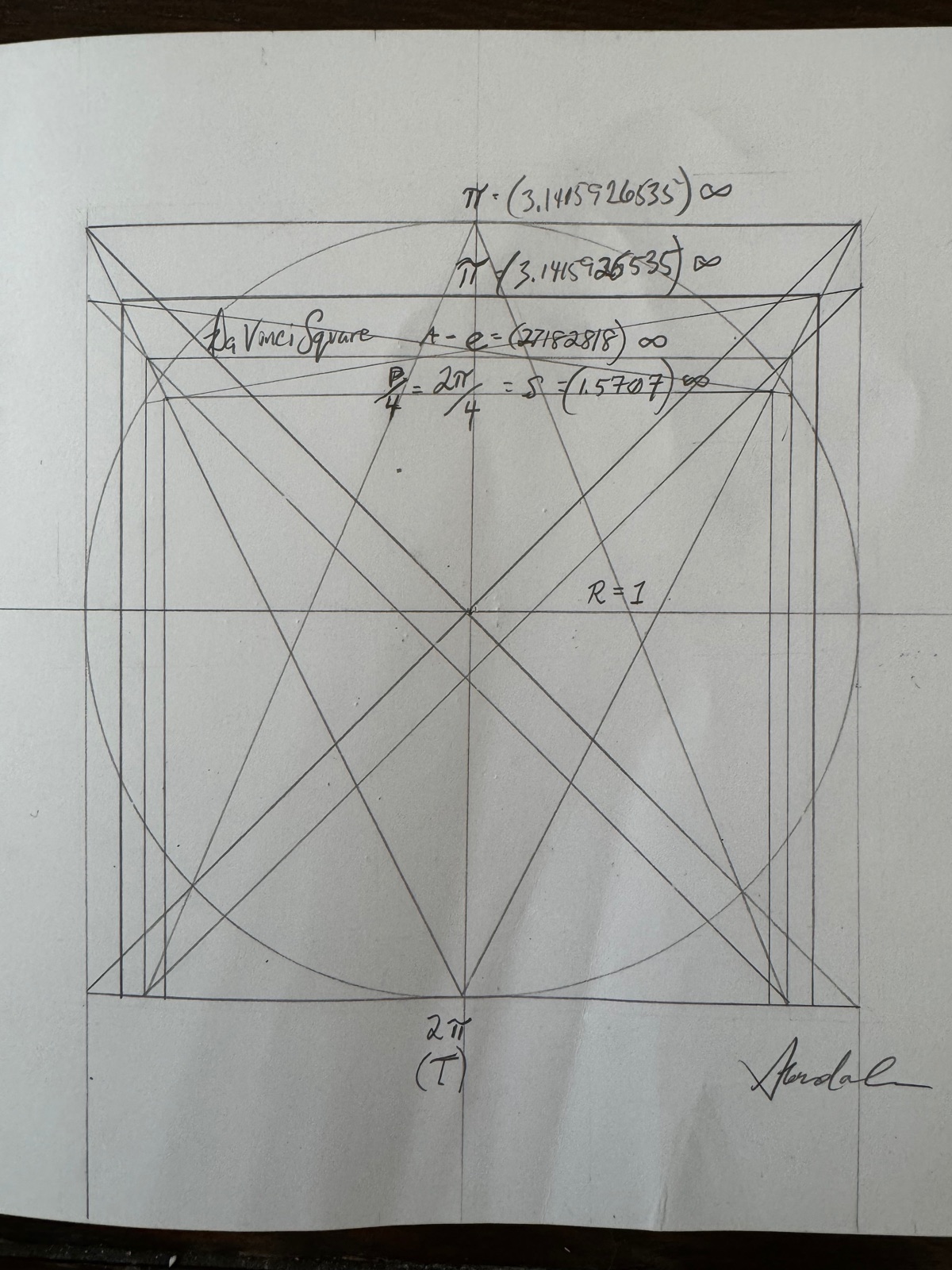
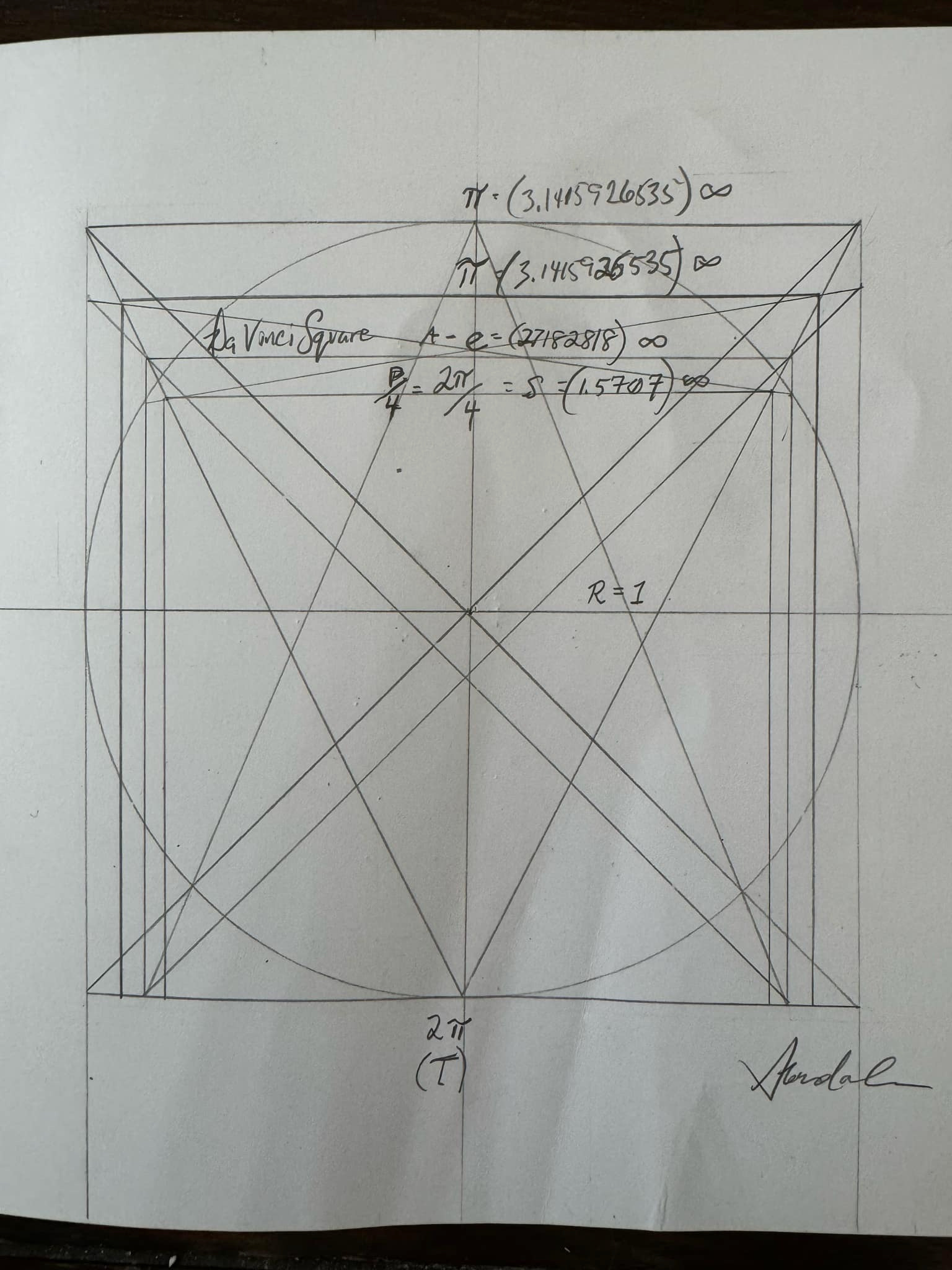
Quadrature study after da Vinci with construction lines and notes in pencil
Study · after da Vinci

Variations on the theme

A second pass at the da Vinci material — same machine, different entrance, the arcs left standing as the working shows.

The principal squaring-the-circle drawing — circle, square, pentagon and vesica in one composition with golden-ratio lengths labeled
The principal drawing · graphite · 2026

Squaring the Circle —
the full composition

The centerpiece study: circle and square in one armature with the vesica piscis, the inscribed pentagon, and the golden lengths — 1, φ, 1⁄φ, √φ, √2 — annotated where they arise. One drawing carrying the whole argument this page unpacks.

Shown whole, uncropped — construction lines, labels and all.

Detail of the Leonardo quadrature study — the rolling wheel rectification
after Leonardo · the roll, close
Second detail of the Leonardo quadrature study — rectangle and geometric mean
after Leonardo · the mean, close