The Lab · Edition № IX · a field guide to the stone
←The Secrets of the Pyramids and the Ancient Sites
The Great Pyramid measured to the millimeter, then everything school left out, at Giza and at the sites that share its numbers: sixteen constants in one fraction and eighty in the building, eight faces at the equinox, Orion on the plateau, Leonardo's blueprint, rooms no one has entered, and a chamber that hums.
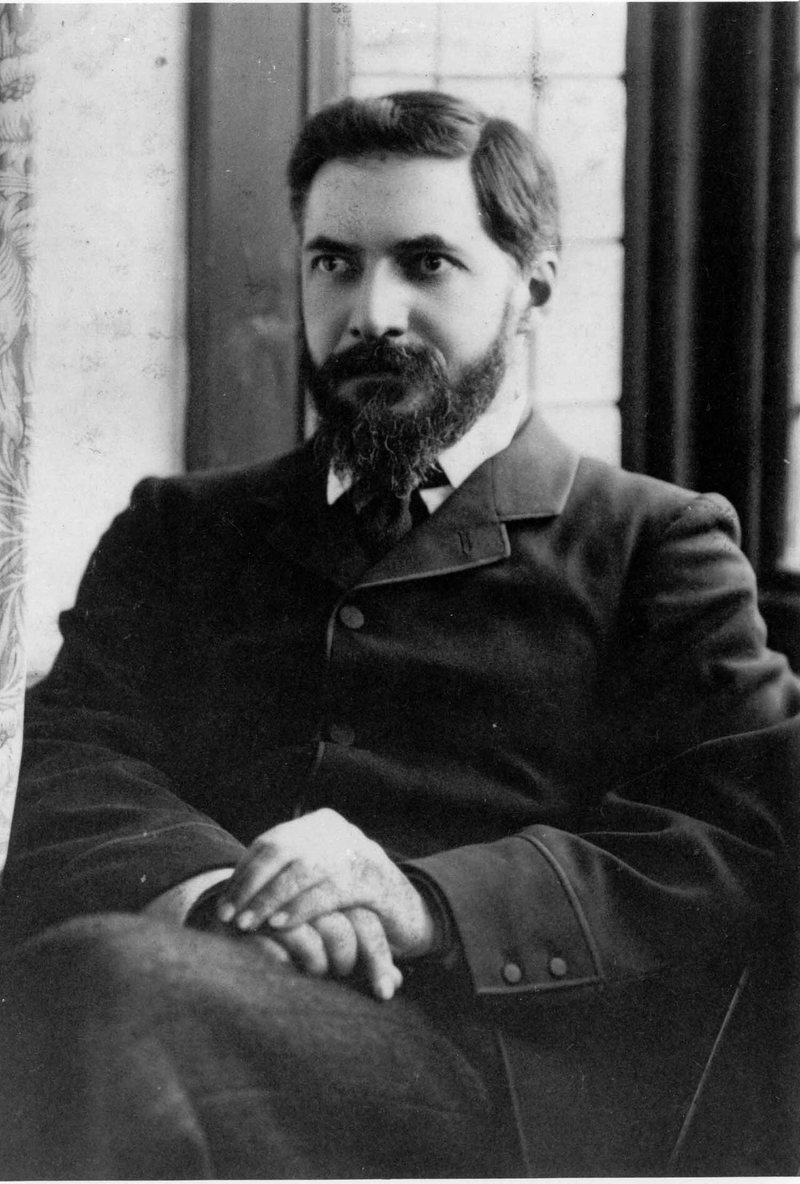
Flinders Petrie, c. 1886. He went to Giza in 1880 to test the "pyramid inch" and came home with the first true survey of the building.
In 1880 a young Englishman named Flinders Petrie spent two winters measuring the Great Pyramid with instruments he built himself. His mean base: 9,068.8 inches — 230.35 meters — the four sides agreeing to 1.8 inches. Cole's survey of 1925 and Glen Dash's of 2015 settle it at 230.36 meters, longest and shortest sides seven centimeters apart: three hundredths of one percent across a quarter mile. The sides face true north to within 3′54″ — a fifteenth of a degree — a thousand years before the compass. Original height 146.7 meters; 138.5 stand today. Surveyed
Over 2.1 million stones, and no standard size among them — each cut to its own dimensions and fitted to its neighbors. Average weight about 2.5 tons; the granite beams over the King's Chamber run 25 to 80 tons and came 560 miles down the Nile from Aswan. Robert Edward Grant's count runs higher: 2.5 million blocks of 20 to 70 tons. At the textbook's twenty-year build that is one block set every two minutes, day and night, for two decades. The polished white casing was laid with joints of half a millimeter, cemented, across a whole face. The earthquake of August 8, 1303 shook that casing loose and Cairo's sultans carted it off for mosques. What stands is the core.
A course is one horizontal layer of stones — a row of bricks, scaled up. There are 203 of them, and they are not uniform either: from 59 inches thick at the bottom to 20 near the top, with thick layers restarting nine times on the way up, like a building drawing breath.
Each bar is one layer; its height is the layer's thickness in inches. Gold marks a restart — a layer more than seven inches thicker than the one under it: 22, 35, 44, 47, 67, 90, 98, 118 and 144, with a last breath at 180.
No body, no king, no burial goods were ever found in any of the three great pyramids. Al-Ma'mun's men broke in around 820 and found the granite box open and empty. Belzoni forced Khafre's in 1818: an open sarcophagus, a broken lid, the bones of a bull. Vyse's basalt sarcophagus from Menkaure's sank with the ship Beatrice in 1838; the coffin lid from the same pyramid is 2,000 years younger than the stone, and the bones with it carbon-date to 658–896 AD. Surveyed
230.36 m
mean base
755.8 ft. Sides differ by 7 cm. Petrie: 9,068.8 in.
146.7 m
original height
481 ft · 280 royal cubits. 138.5 m today.
51°52′ ± 2′
face slope · Petrie
Seked 5½ palms — 14 up for 11 across.
3′54″
from true north
Dash 2015. A fifteenth of a degree.
2.1M+
stones
~2.5 tons each; ~6 million tons in all.
0.5 mm
casing joints
Petrie: "one fiftieth of an inch."
2.28 × 0.98 × 1.05 m
the granite coffer
~3 tons. Wider than its passage.
0
bodies found
820 · 1818 · 1837.
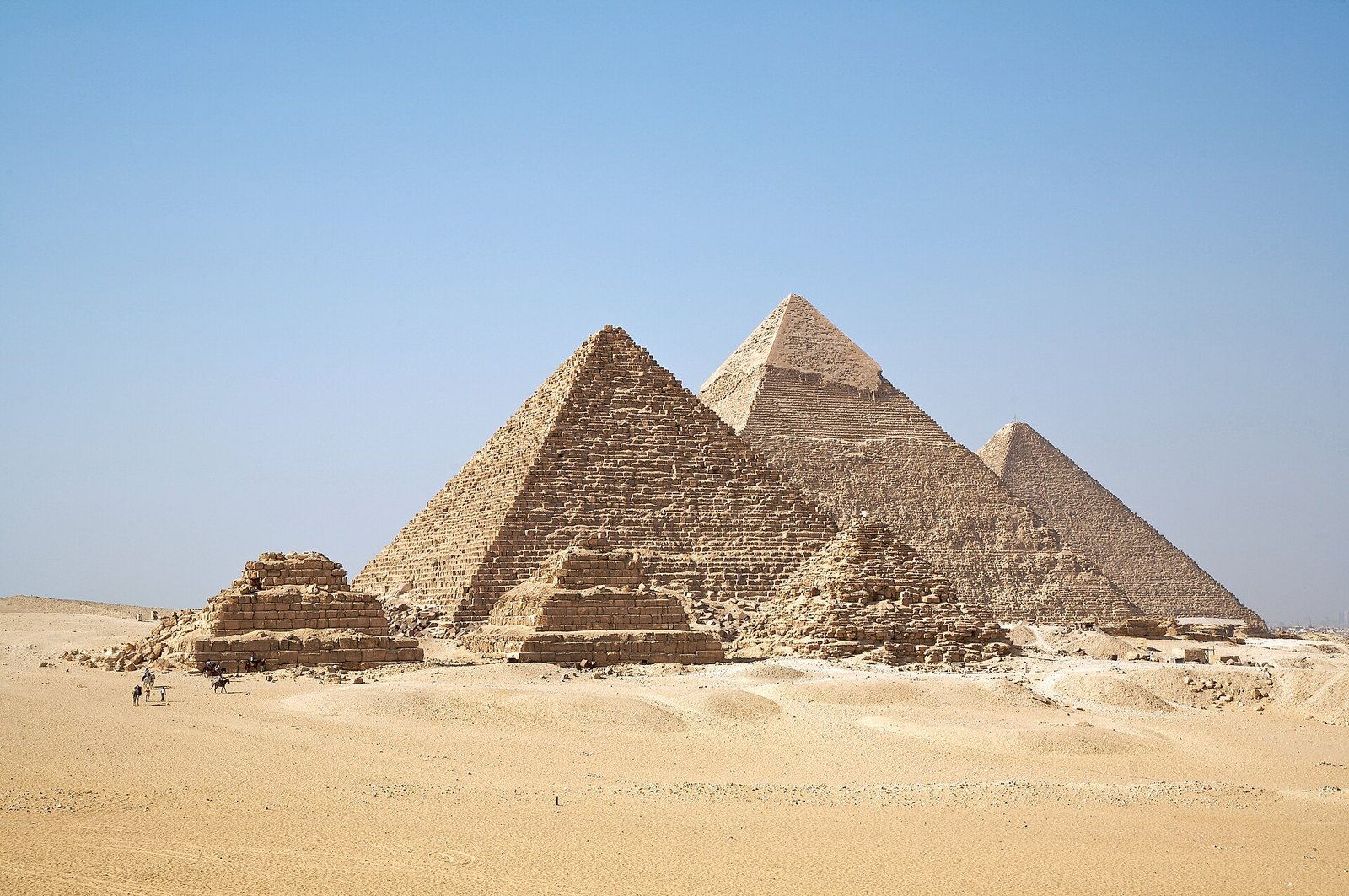
Menkaure, Khafre, Khufu. Photograph Ricardo Liberato, CC BY-SA 2.0.
II · The constants
Sixteen numbers in one fraction
In 1859 John Taylor, a London publisher who never saw the pyramid, noticed that its height is to the perimeter of its base as a radius is to a circumference. With Petrie's numbers: perimeter over height is 6.2857; 2π is 6.2832. Four hundredths of one percent. He also read in Herodotus that each face's area equals the height squared — which makes the slant height to the half base the golden ratio, φ. Observed
The builders set slopes by seked — the horizontal run, in palms, for one cubit of rise, exactly as the Rhind papyrus teaches. The Great Pyramid's seked is five and a half palms: 22 across for 28 up.
the face slope. Petrie measured 51° 52′ ± 2′
0.040 %. Taylor, 1859: height to perimeter as radius to circumference
0.034 %. Herodotus: each face equals the height squared
0.040 %. The section has the area of the circle whose diameter is the height
the corner edges rise nine in ten
Pick a constant. The two lengths that make it light up, and the page does the division in front of you.
The constants engine440 × 440 × 280 royal cubits · Derived · Observed
Cycling. Choose one to stop.
Why one slope lands on both π and φ
14/11 sits between them: 0.04 % from one, 0.06 % from the other
The builders had to choose one number. They chose the one that hits both. Derived
Then the number leaves the plateau
0.002 %. Set the Moon on the Earth: their height over the Earth's radius is the pyramid's height over its half base
−0.37 %
−0.68 %
72 years is one degree of the precession
Set the Moon on the Earth and their combined height over the Earth's radius is the pyramid's height over its half base — to two thousandths of a percent, closer than any survey of the pyramid itself. Scale the pyramid by 43,200 and it becomes the planet. Observed
Grant's count: more than eighty
The engine above recomputes the sixteen that fall straight out of Petrie's numbers. Grant's tally for the whole building runs past eighty mathematical and physical constants, several of them found only in the last 150 years: π, φ, e and the fine-structure constant, Brun's constant (1919), the tribonacci constant, the Planck length and the Planck time, the upsilon constant of particle physics, and the speed of light. The building was set out in a unit he calls the long cubit, 1.75 feet, and in that unit every dimension is a multiple of 432: height 275, which is 432 × 7/11; half base 216; base 432. His working is in his own account of the pyramid and the Codex Universalis. Observed
Which came first — the constants, or the pyramid? A constant is the same for all time. So the constants came first, and the only question is who knew them, and when.
III · The three measures
The cubit, the foot, and the meter — one system
Three units from three worlds. The royal cubit, the pyramid's own unit, said to be the length of a forearm. The foot, said to be a foot. The meter, defined by France in 1791 as one ten-millionth of the distance from the North Pole to the equator. Nobody who made any one of them knew the others. Here is how they fit. Observed
Petrie's own cubit, 20.632 in = 0.5241 m, is 0.09 % off
So the foot is unity, the cubit is the growth on it — e is the number banks use for continuous compounding, and e − 1 is what one dollar earns in a year at 100 percent — and the meter is the cubit turned into a circle. Growth in a line, growth in a circle, and the three together come back to a whole number of feet. The amazing question is not whether this is so. It is: how did a forearm, a foot, and the size of the Earth end up inside each other, in one building, with nobody in the room who knew all three? Observed
IV · Eight faces
Four sides from the ground. Eight from the air.
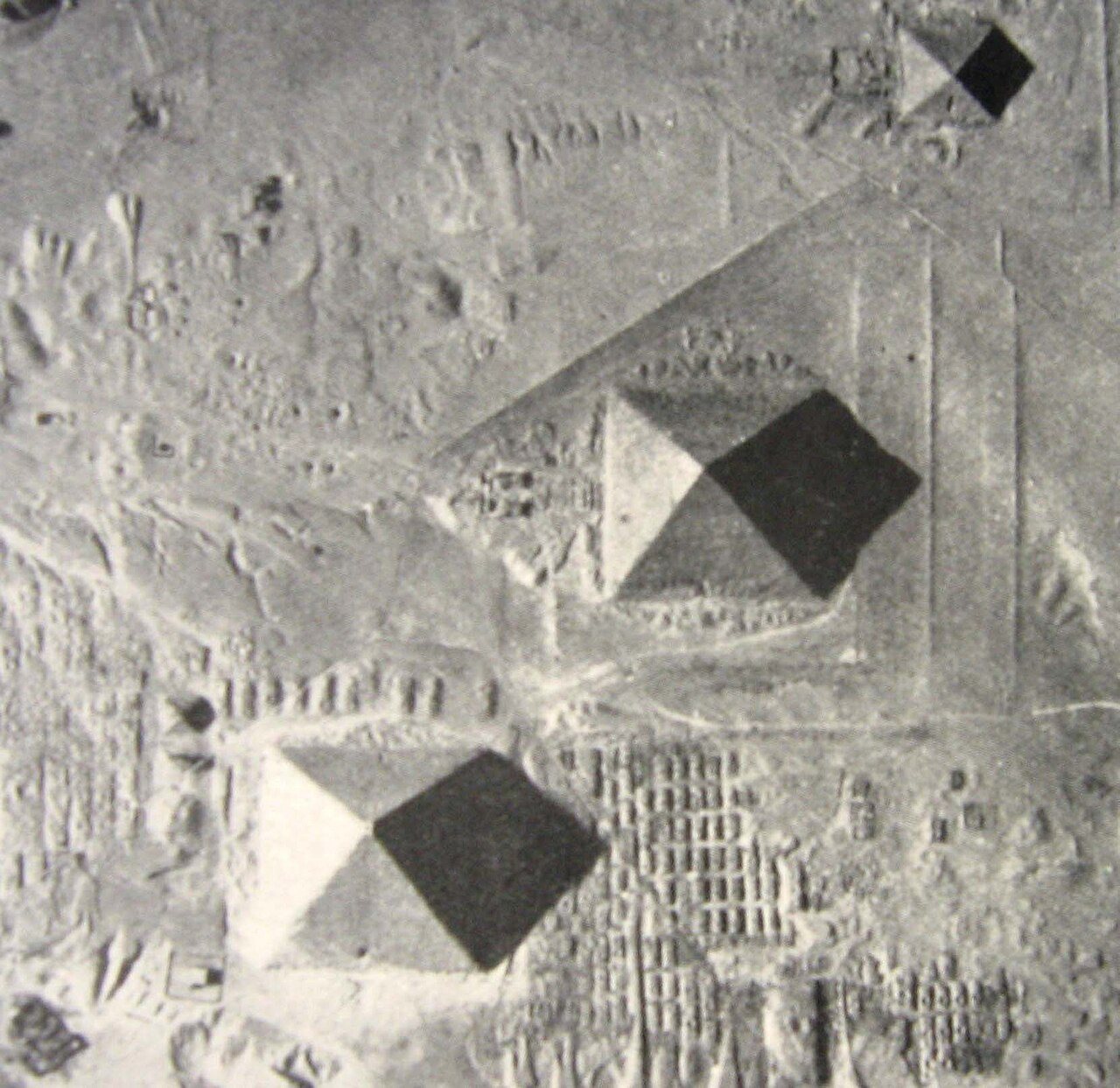
Each face is folded along its center line — hollowed so the middle of every side sits about a meter behind its corners. Petrie put the hollowing at 37 inches on the north face in 1883; the 2004 laser scan and the 2018 photogrammetry find it more than two meters deep in places. It is half a degree of rotation on a face 186 meters tall, invisible in ordinary light. Surveyed
It appears when the sun grazes a face edge-on. At the equinoxes the sun rises due east and sets due west, so its light runs exactly along the north and south faces and each splits — one half lit, one in shadow. Brigadier P. R. C. Groves photographed it from the air in 1926; André Pochan caught it in infrared at an equinox sunset in 1934. Menkaure's core has the same fold; Khafre's and the Red Pyramid's do not. Watch a day pass. Observed
The Groves photograph, 1926: each face split down its middle. The Great Pyramid at lower left, Khafre center, Menkaure top right. Published by Jean Capart, 1930. Public domain.
A day at the equinox, on the satellite imagePléiades, 2021, from directly above · faces folded 0.56° · Derived
AzimuthAltitude
The real stone from orbit, with the computed light for the hour laid over it. The satellite passed in the morning, so the west faces already lie in shadow; watch the north and south faces split at sunrise and sunset. Groves caught the same split on film in 1926, above.
V · The star map
Three pyramids, three stars
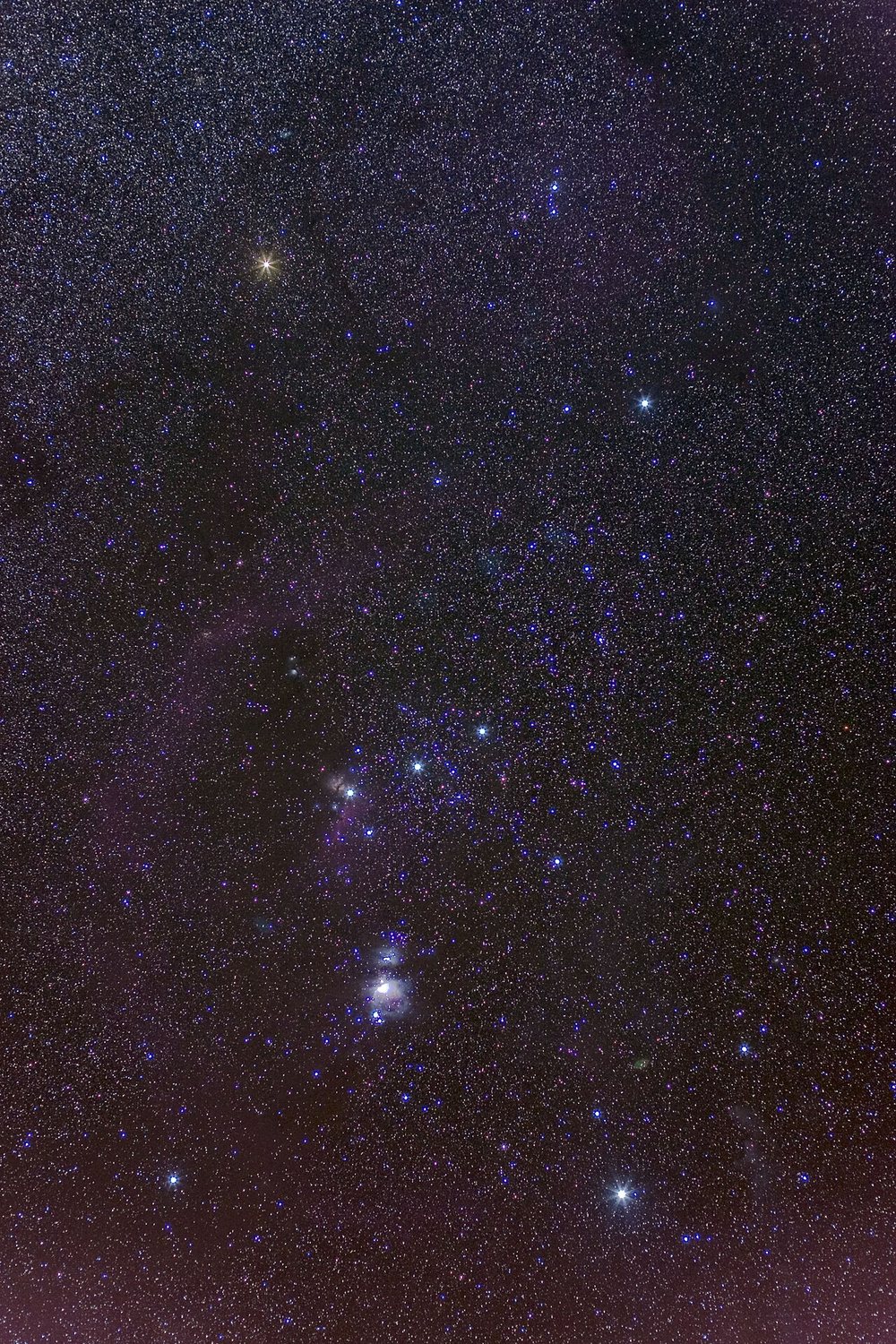
In 1989 Robert Bauval laid a star map over the plateau and saw Orion's belt: Alnitak on the Great Pyramid, Alnilam on Khafre, Mintaka on Menkaure, the small one set off the line as Mintaka is set off in the sky. The map has to be turned south-up — the way an Egyptian stood, facing Orion — and then it lies down on the sand. The bend at Khafre is 11.5° on the ground and 7.5° in the sky; the second gap is 7% shorter on the ground and 2% longer in the sky. Run the belt's tilt back through the 25,920-year wobble of the Earth's axis and it matches the plateau's diagonal around 10,450 BC — Bauval's First Time. Observed
Orion over GizaNASA Space Station photograph, 2021 · belt stars fixed on the pyramids · Derived
Four shafts, four stars
Each upper chamber has two shafts, 20 cm square, cut toward the north and south faces. Badawy and Trimble, 1964: the King's Chamber's south shaft (45°) points at Alnitak crossing the meridian; its north shaft (32.5°) at Thuban, the pole star of the age. Bauval, 1994: the Queen's Chamber's south shaft (39.6°) at Sirius, its north shaft (39.1°) at Kochab. All four work in one epoch, 2450–2550 BC. In 1993 Gantenbrink's robot climbed 65 m up the Queen's south shaft to a small door with two copper pins; a second robot drilled it in 2002 and found another slab; Djedi, in 2011, read red marks on the floor between. Surveyed
Where the shafts lookBadawy & Trimble 1964 · Bauval 1994
Orion. The belt, center; the sword below it. Photograph by Mouser, CC BY-SA 3.0.
The diagonal, and the spiral
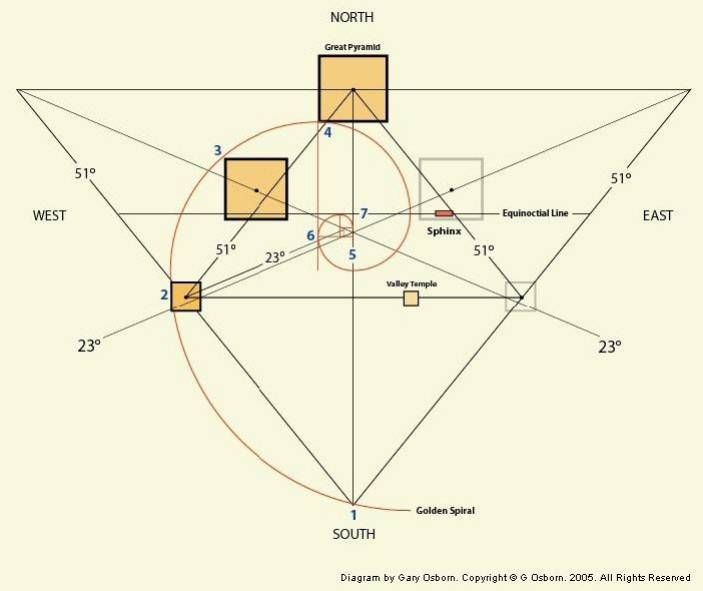
A line through the south-east corners of all three pyramids runs 43° east of north, straight at Heliopolis, 20 km away; Khafre's corner misses it by 12 m. The rectangle holding all three — Khufu's north-east corner to Menkaure's south-west — is 35,721 by 29,228.7 inches on Petrie's survey: 11 to 9, which Grant and Green scale to 528 by 432. A golden spiral with its eye on the Sphinx sweeps through Khufu and past the other two; Grant's mod-24 spiral runs the corners of all three and the Sphinx's left paw. Observed
The plan as a spiral. Diagram by Gary Osborn, 2005.
Osborn draws the plateau north up, the Great Pyramid at the top and a point far to the south, marked 1, where two lines climb at 51° to the west and the east: the face angle of the pyramid, laid flat on the ground. A second pair of lines leaves the same figure at 23°, within half a degree of the tilt of the Earth's axis, and the equinoctial line runs east and west through the Sphinx, the line the sun rises along at the equinox. The golden spiral starts at the south point and takes the three pyramids in order: 2 is Menkaure, 3 is Khafre, 4 is the Great Pyramid, whose apex it crosses, then it tightens through 5 and 6 to its eye at 7, on the equinoctial line beside the Sphinx and the Valley Temple. Seven points, the number of the heptagon in section X. The spiral on the satellite image above is the same curve with its eye on the Sphinx. Observed
The plan of the plateauPetrie's centers, meters · over the satellite image · Derived
VI · Leonardo
The blueprint that went to Italy
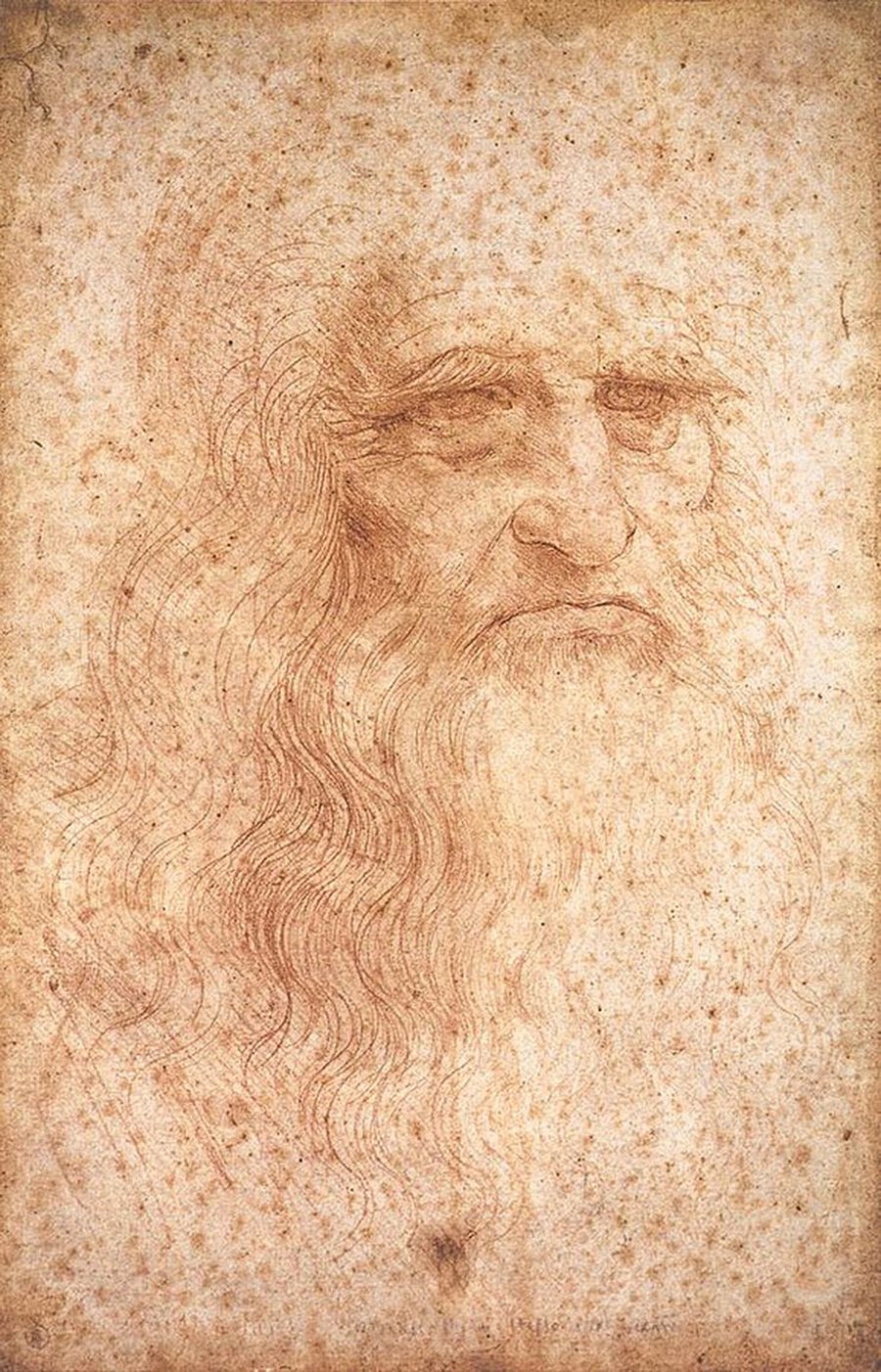
Leonardo, red chalk, c. 1512. Biblioteca Reale, Turin.
In 1482 Leonardo leaves Florence and the Italian record loses him for three years. He surfaces in 1486; the first great work after his return is the Vitruvian Man. Where he went is in his own hand: a letter in the Codex Atlanticus to the Devatdar of Syria, lieutenant of the Sultan of Cairo — Qaitbay, the Mamluk who traded with the Medici and hired European polymaths to build his mosques. Leonardo describes arriving in Cairo and, in detail, the great Mount Taurus: a peak that seems to touch the sky, whose east face of the whitest stone catches the sun four hours before day. Bull Mountain is the old name of the Great Pyramid; its plateau was Rostau — Tauros backwards, the bull of Apis. Every polymath went: Pythagoras spent 30 years in the mystery schools, Plato went, initiation required it. And Leonardo wrote this letter forwards, not in his mirror hand — his signal to look closer. Observed
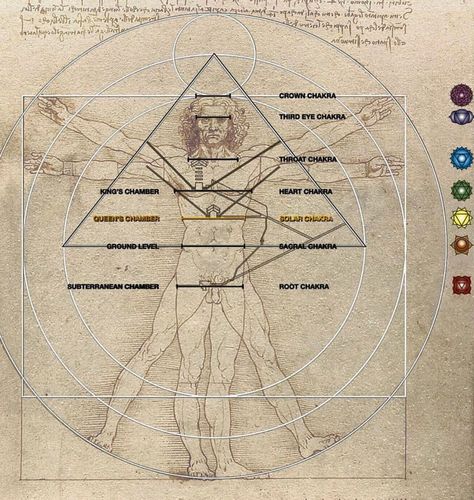
Set the pyramid over the Vitruvian Man — base on the navel, apex at the crown — and his horizontal lines become a section drawing: the groin on the Subterranean Chamber, the navel on ground level, the chest lines on the Queen's and King's Chambers, the shafts framing the raised arm. Beneath the drawing Leonardo writes that opening the legs lowers a man's height by one fourteenth. Set cut Osiris into fourteen pieces; Isis gathered thirteen, and the moon wanes fourteen nights and waxes fourteen. The fourteen-part module places every chamber. Raise a circle inscribed in the square to the navel and six pyramid sections appear, with the 14:11 Earth–Moon proportion among them. The three diamonds on the abdomen are the three pyramids — the belt — with the Sphinx before them. The throat line meets the void found above the Grand Gallery in 2017; Grant placed a chamber there from the drawing before the muon detectors reported it. The forehead, the crown and the knees mark chambers still unopened. Seven chakras, seven levels of the building. Observed
the base of the square is tangent to the circle
navel to the top corner, from the vertical. The pyramid's face: 51.84°, 0.27 % apart on the ratio. Leonardo's two upper hands point at that corner
The pyramid in the squareLeonardo, c. 1490 · Gallerie dell'Accademia · Observed
Osiris in fourteen pieces, or forty-two
The body as the building: chambers on the left, energy centers on the right.
Read the sheet from the top. The apex sits on the crown of the head, the base on the navel, so the man above the navel is the pyramid and the man below it is the bedrock. Down the left the rooms: the King's Chamber on the line of the chest, the Queen's Chamber in gold at the solar plexus, ground level at the navel, the Subterranean Chamber at the groin. Down the right the seven centers of the body in the Indian and Egyptian schools: crown at the apex, third eye at the forehead, throat, heart at the King's Chamber, solar plexus at the Queen's, sacral at the pavement, root under the ground. The two shafts leave the King's Chamber for the corners of the square, the line of the outstretched arms. Put the levels on the ruler in section VII and they land in order: root at −30 m, sacral at 0, solar plexus at 21 m, heart at 43 m, throat at 60 to 75 m where the void was found in 2017, third eye at 125 m, crown at 146.7 m. Seven centers, seven levels, one body. Observed
The story behind the fourteen. Osiris came to Egypt as king, gave the people their laws and taught them to farm and to live in peace. His brother Seth crept into his room at night and measured his body, top to bottom and side to side, and had a carpenter build a chest, painted and sheeted in gold, to those exact measures. At a feast Seth offered the chest to whoever fit it. Osiris lay down, it fit him perfectly, Seth sealed the lid and sent it down the Nile. Isis found the chest and hid the body in the river grass; Seth found it again and cut it into fourteen pieces, which he threw across Egypt. Isis became a bird and flew the length of the country gathering them, and with Nephthys, Thoth and Anubis sewed the body whole, wrapped it head to toe in linen, the first mummy, and on the night of the full moon raised him. He could not stay: he went to rule the dead, and told her she would bear Horus, who fought Seth, lost his left eye and had it restored, the Wadjet, the eye of healing, and took the throne of the living. Note what the story is made of: a body measured in secret, a box built to its measure, a lid, a river, a moon, a count of pieces, an eye. The chest made to the measure of a man's body is the coffer in the King's Chamber, a box cut to a man's length, set in place before the roof went on. Observed
Fourteen is the count in Plutarch, the Greek priest who wrote the story down around the year 100. It is the moon's count: fourteen nights of waning from full to dark, fourteen of waxing back, and Osiris in the allegory dies at twenty-eight, a lunar month. The Theosophical reading keeps the number: Osiris is the first cause, the self-created god, and when he is divided he becomes Seth, Isis, Nephthys and Horus, his own aspects; as a solar god he carries the twelve signs beneath him, and his seven dual aspects are the fourteen members of his body. Four of those aspects are named: Osiris-Ptah, the light; Osiris-Horus, the mind; Osiris-Lunus, the moon and the psychic body; Osiris-Typhon, the physical and passionate body. So fourteen is the body of a man, and Leonardo's caption under the drawing says the same thing in a draftsman's words: open the legs and the height drops by one fourteenth. Thirteen pieces were found. The fourteenth, the phallus, had gone to the fish, and Isis made it new in gold, so the body that rose was thirteen parts found and one part made. In the Rosicrucian and Masonic reading that is the whole of the work: gather what was scattered, make the missing part, raise the body. Observed
Forty-two is Egypt's own count. The temple lists of the late period, at Dendera, Edfu and Philae, give each province of Egypt a relic of Osiris, and there were forty-two provinces, twenty-two in the south and twenty in the north. In that reading the body is the land: every district holds a piece, the whole country is Osiris laid out along the Nile, and the yearly rising of the river is Isis gathering him. Forty-two is also the number of the judges in the Hall of Two Truths and of the declarations of innocence the dead recite before them in the 125th spell of the Book of the Dead, one to each judge, one to each province, and the number of the books of Thoth that Clement of Alexandria says the priests carried in procession, thirty-six on the world and the heavens and six on the body and its healing. So the fourteen is the moon, the body and the measure; the forty-two is the land, the law and the library. Both are the same body counted at two scales, the man and the country, and the building holds both: fourteen parts on Leonardo's sheet, and thirty-six decans on the walls of the King's Chamber with six more for the floor and the roof. Observed
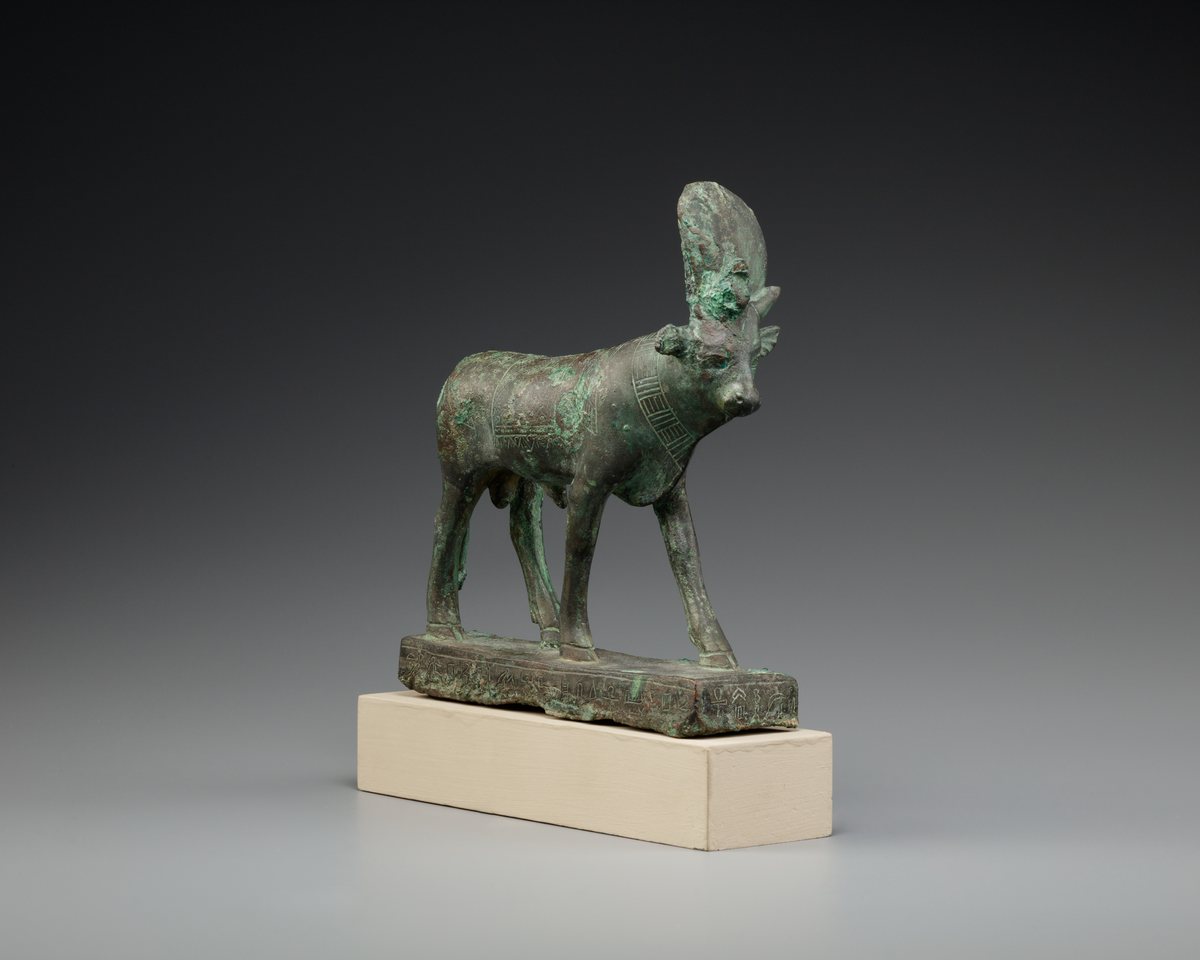
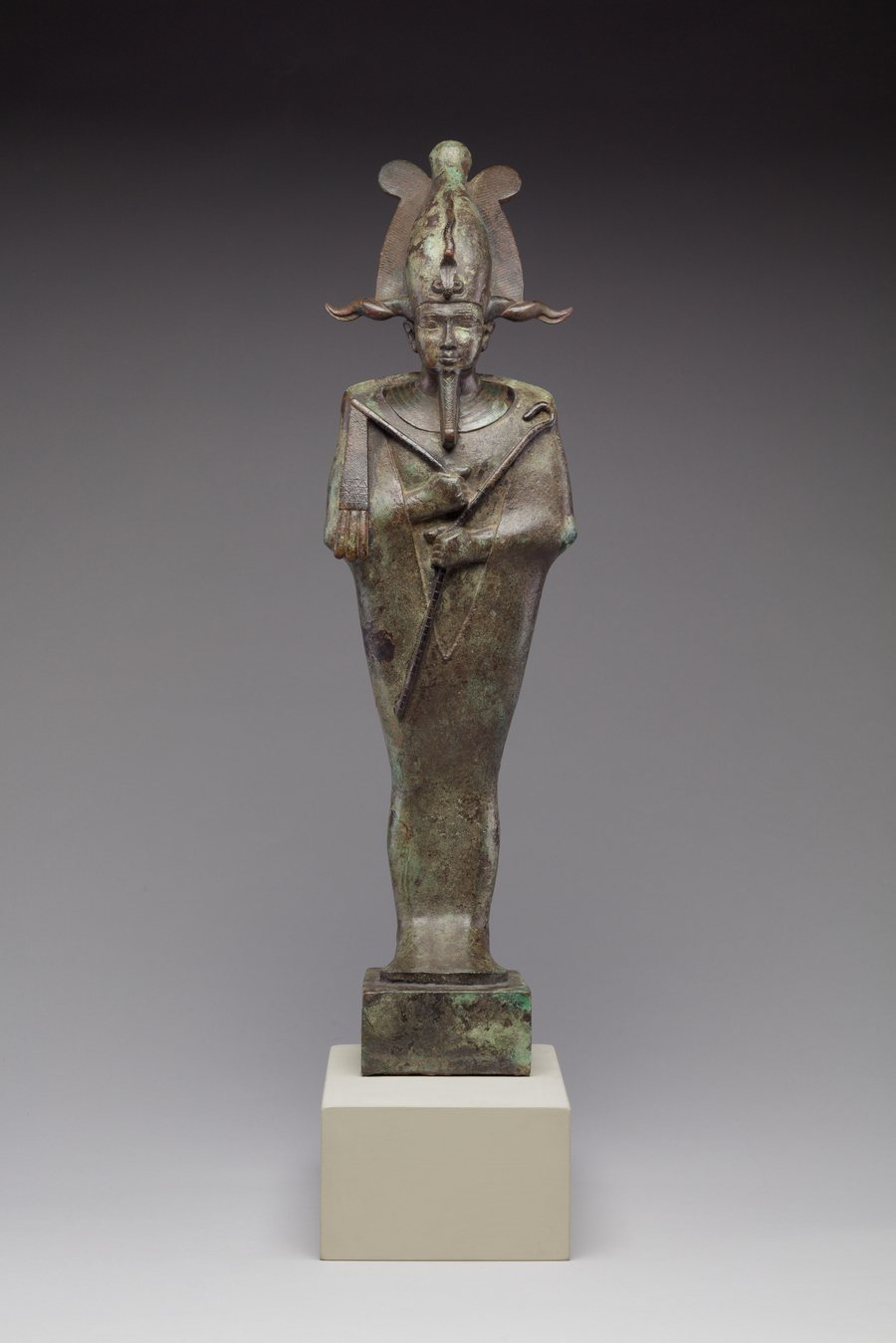
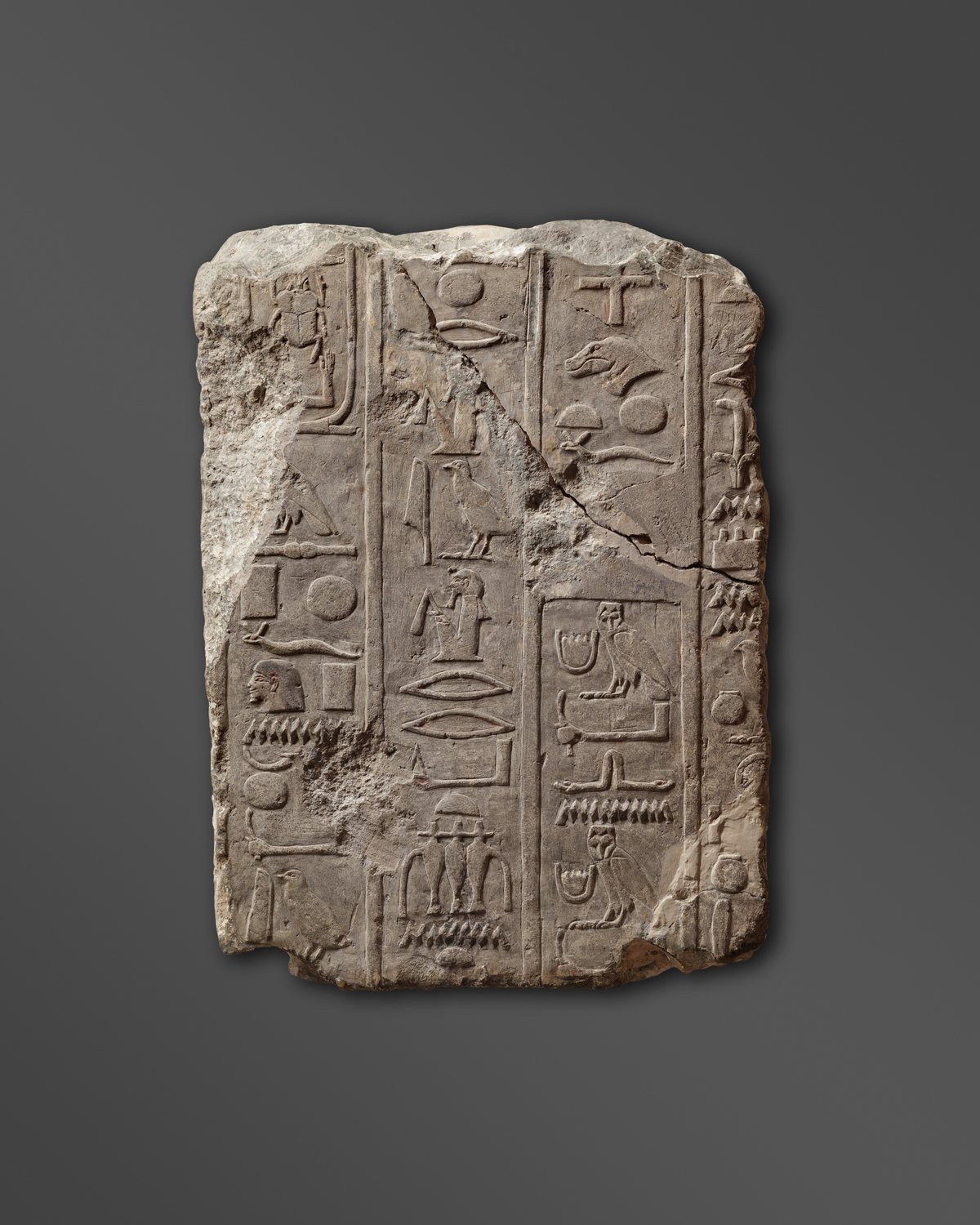
Apis. The bull of Memphis, whose name the pyramid carried: Bull Mountain. Bronze, 664–332 BC. The Met, CC0.Osiris. Cut into fourteen pieces by Set; the fourteen lines on Leonardo's man. Bronze, 664–332 BC. The Met, CC0.The writing. Annals of Thutmose I, limestone, c. 1500 BC. The Met, CC0.
Khufu's base and slope give Khafre's base
Menkaure's base gives the same
Khafre's base gives Khufu's
Menkaure, Khafre, Khufu in long cubits, read off the drawing's lines
The Salvator Mundi, Christ holding a crystal sphere, carries the pyramid's constants in its geometry. The same inverted pyramid sits between Christ and the figure at his right in the Last Supper; lay the King's Chamber's west wall over the painting and the coffer falls in the doorway where Christ's feet were. Observed
VII · Inside
Every room we know, and the ones we don't
The entrance is 17 m up the north face, 7.3 m east of center, under two limestone chevrons. The Descending Passage drops at 26°31′ for 105 m to the Subterranean Chamber, 30 m below the base and cut into bedrock, left rough, with a square pit in its floor. Partway down, the Ascending Passage climbs at the same angle to the Queen's Chamber — on the axis at 21 m — and to the Grand Gallery: 47 m long, 8.6 m high, seven corbels. Through an antechamber with portcullis slots, the King's Chamber: floor at 43 m, Aswan granite, nine beams and five relieving compartments above, its center 11 m south of the axis. Surveyed
Then the rooms nobody has entered. 1986: French microgravimetry finds a low-density zone behind the west wall of the Queen's passage; a drill breaks into a cavity of quartz sand at 3 m. 1987: Waseda University's radar reports cavities beside and beneath the same passage. 2008: Jean-Pierre Houdin's internal ramp, wound inside the faces, and two antechambers north of the King's Chamber. 2016: muons see a void behind the north-east edge. 2017: the Big Void — at least 30 m long, cross-section like the Grand Gallery's, 40–50 m above the Queen's Chamber floor, found by three muon methods independently. 2023: the North Face Corridor — 9.06 by 2.02 by 2.18 m, horizontal, 0.84 m behind the chevrons — confirmed with a 6 mm endoscope. 2025: resistivity imaging finds a 2.5 m anomaly a meter under the base. Leonardo's forehead, crown and knee lines, and Grant's reading of them, put chambers where nothing has been opened. Solid is entered; dashed is detected; dotted is predicted. SurveyedObserved
The cutawayPetrie's levels · ScanPyramids 2017 & 2023 · to scale · Surveyed
Hover or tap any space.
The room built on three, four, five
length, width, height
end wall diagonal, floor, corner to opposite corner
Petrie's height, 230.09 in, against the design's 230.4. Perimeter 60 cubits = 10π m
The height is half the floor's diagonal — chosen so every diagonal in the room is a whole number. A 3-4-5 triangle standing in three dimensions, two thousand years before Pythagoras. Derived
The walls carry the sky. Robert Edward Grant has spent seventeen nights in the room, scanned it with lidar and rebuilt it for Apple Vision Pro, and mapped the 36 decans — the ten-day stars of the Egyptian calendar, three to each sign of the zodiac — around its four walls in order. Taurus centers the north wall: the Apis bull and Hathor's cow under the face of Orion, Lyra across his brow, Cygnus beside, Draco and the four bears above. The east wall holds Capricorn to Pisces: a woman on Pegasus loosing Sagitta at Aquila, the fish of Piscis Austrinus above the wing — Delphinus, Pegasus, Aquila, Sagitta, the Southern Fish. Leo watches the coffer from the west. A double helix crosses Orion's mouth. The floor's 2:1 is the proportion of the four pole stars of precession — Polaris, Deneb, Vega, Thuban — and of Orion; scaled to the room the coffer is the belt. Turn the room. Observed
The King's Chamber, turning — with its 36 decans20 × 10 × √125 royal cubits · decans as Grant maps them · Derived · Observed
floor 20 × 10 · height 11.18 · wall diagonal 15 · space diagonal 25 · 36 decans, 9 to a wall
The rim of the box: Alpha, Omega, and a compass
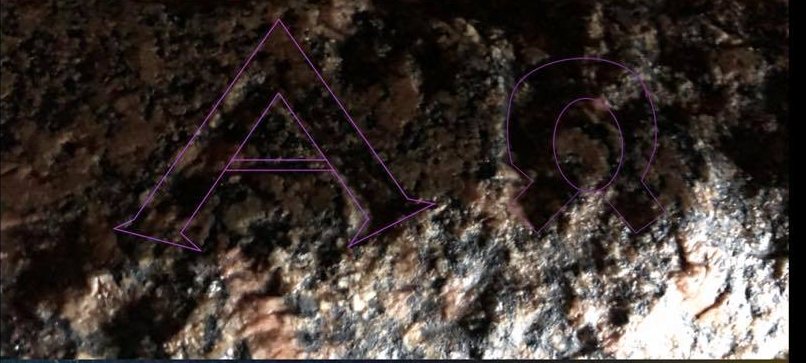
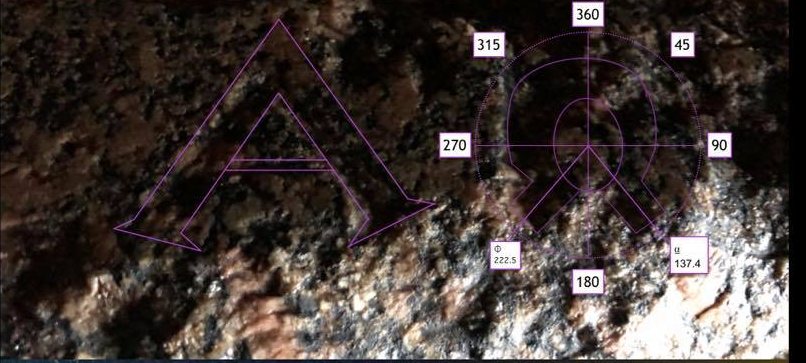
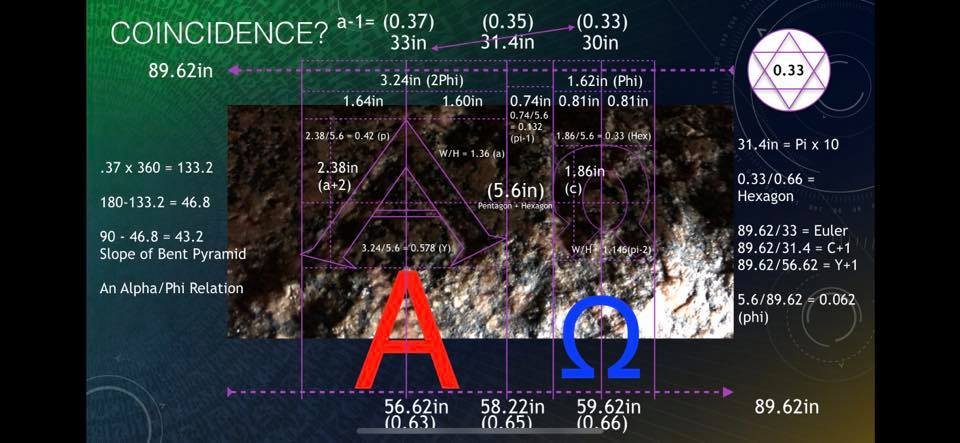
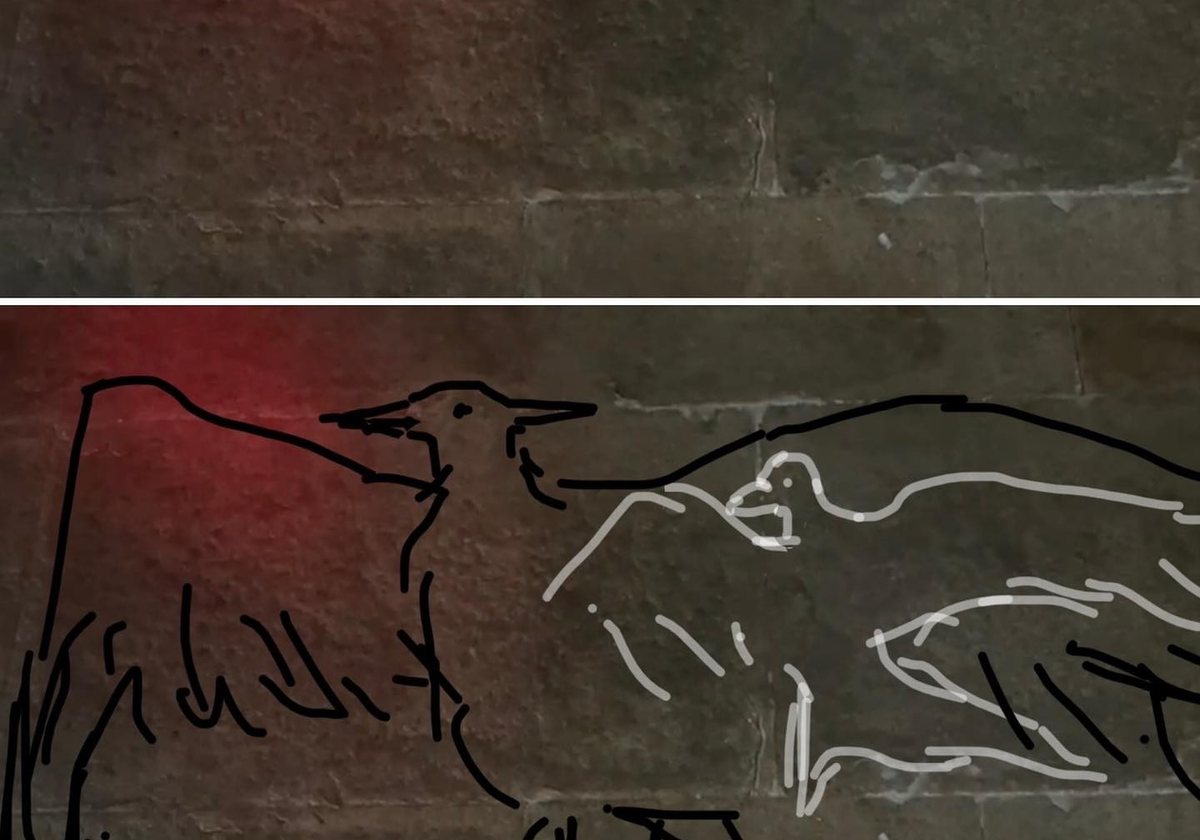
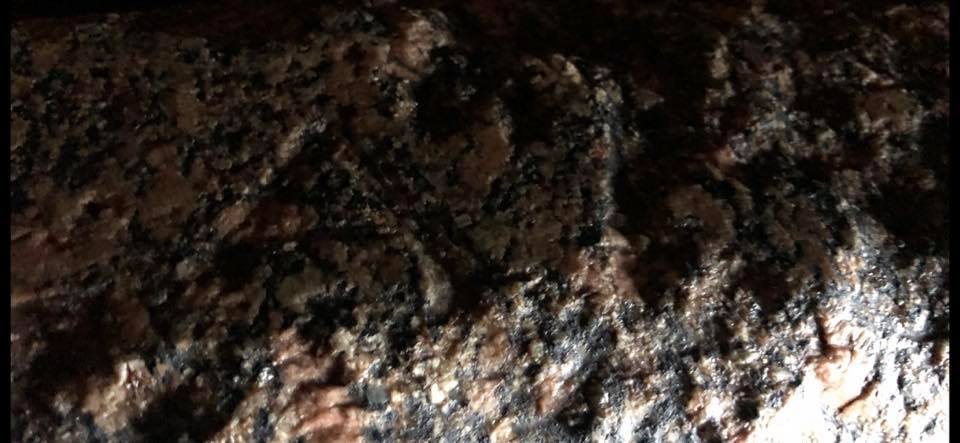
On May 7, 2018, on the first of two nights inside, Grant found three markings on the back rim and the side of the box that appear in no survey of a room studied for centuries: an Alpha, an Omega, and a compass. They are not scratched in; they are pressed into the granite, debossed. The A stands 3.24 inches wide, which is 2φ, and the Ω 1.62, which is φ; the pair together span 5.6. The A's height is 2.38 inches, the Ω's 1.86, and 1.86 over 5.6 is a third, the hexagon's number. They sit 56.62, 58.22 and 59.62 inches along the 89.62-inch rim, 0.63, 0.65 and 0.66 of its length, which leaves 33, 31.4 and 30 inches to the far end: 89.62 divided by 33 is 2.716, Euler's e; 31.4 is 10π; 89.62 divided by 56.62 is 1.583, the Euler-Mascheroni constant plus one; 5.6 divided by 89.62 is 0.0625, one sixteenth. Take 0.37, the A's distance as a fraction of the rim, times 360: 133.2. From 180 that leaves 46.8, and from 90 that leaves 43.2, the upper slope of the Bent Pyramid at Dahshur. Observed
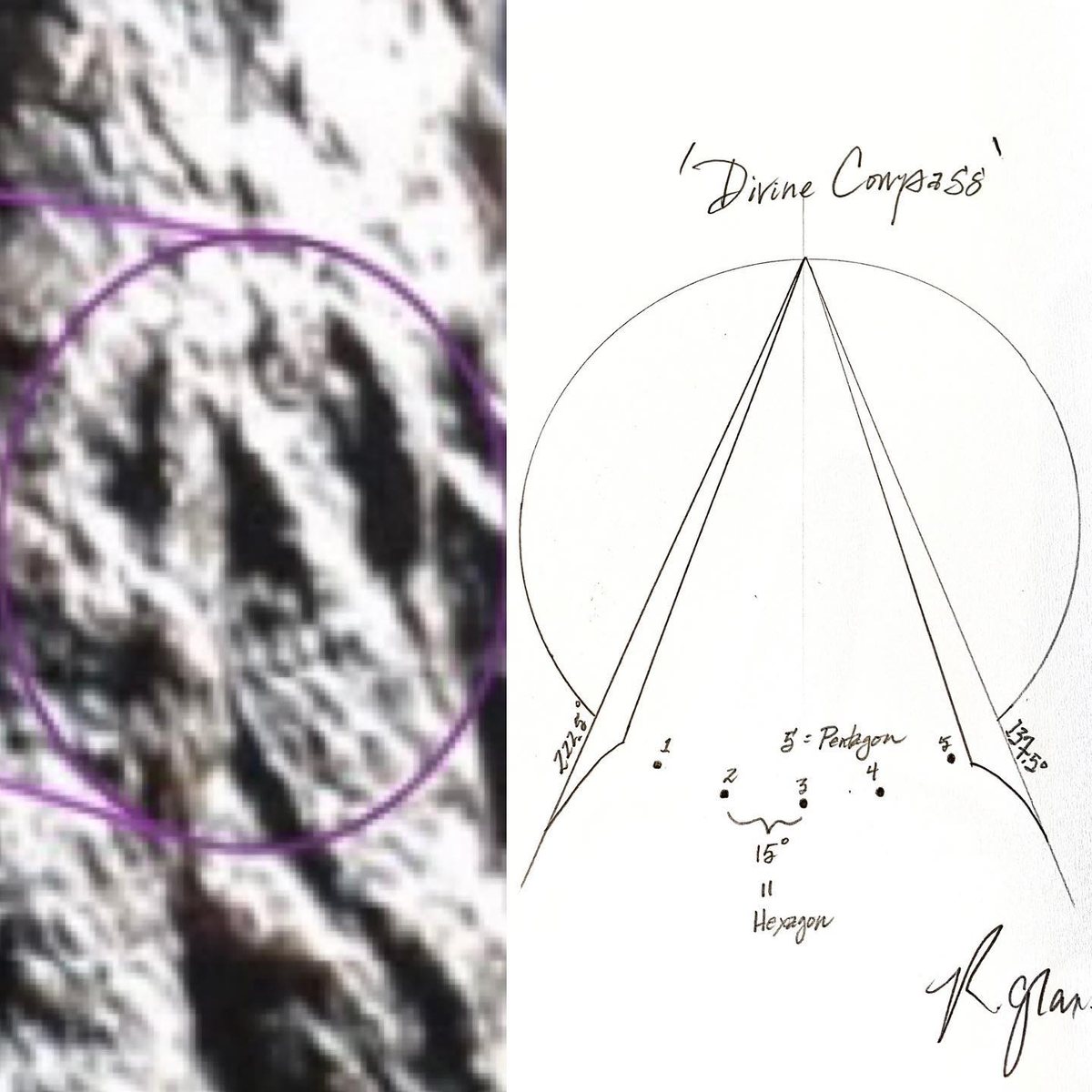
The compass on the side opens at 30°, a twelfth of the circle, the hexagon's angle halved: the working compass of every architect since, and of the square-and-compass on every lodge door. Set the Ω in a circle of degrees, its ring at the top, and its two feet fall at 137.5° and 222.5°. Those are the golden angle and its complement, 360/φ² and 360/φ, the angle a plant turns between one leaf and the next; and 137.5 is the fine-structure number, 137.04, to a third of a percent. Grant's own sheet, the Divine Compass, draws the two arms from the apex of a pyramid inside a circle, five points between them for the pentagon and 15° for the hexagon. Derived
the Alpha and the Omega on the rim · traced · Robert Edward Grant, 2018the Ω in a circle of degrees: 222.5° and 137.4°the compass on the side, and the Divine Compass sheet
The rim, measuredGrant's measures, May 2018 · the letters · the rose · the 137 boxes · Observed · Derived
the widths on the rim, 0.1 %
the rim over the distance to the far end; the middle mark; the rim over the distance to the A
the Bent Pyramid's upper slope, from the A's place on the rim
the Ω's two feet in the circle of degrees: the golden angle, and the fine-structure number to 0.3 %
the room over the box, 0.1 %
the width of the room; the box's width over it
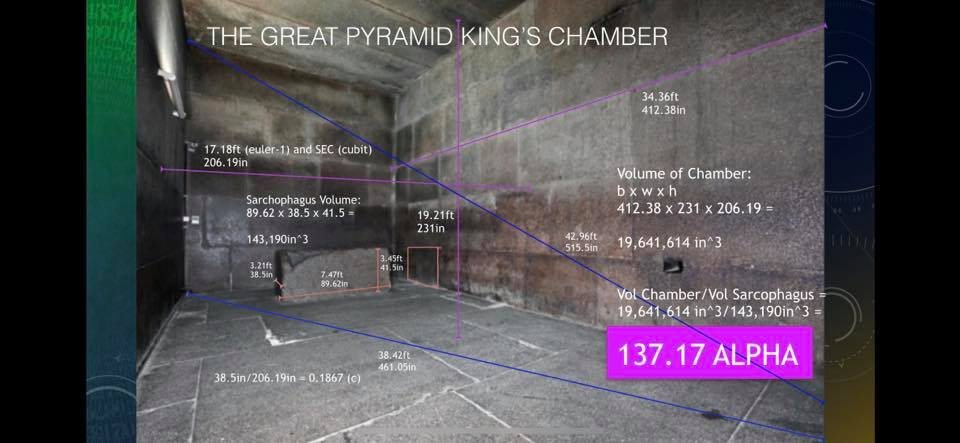
every dimension on the rim, and what it divides into · Grant's sheetthe chamber in inches: 412.38 × 206.19 × 231 · the box 89.62 × 38.5 × 41.5 · the ratio 137.17
The room to the box. The chamber is 412.38 by 206.19 by 231 inches: 19,641,614 cubic inches. The box is 89.62 by 38.5 by 41.5: 143,190. Divide, and the box fills the room 137.17 times; 1/α, the fine-structure constant, is 137.04, a tenth of a percent away. The width, 206.19 inches, is 17.18 feet, ten times e − 1, the same digits as the cubit in feet. The box's width over the room's, 38.5 over 206.19, is 0.1867: the speed of light in miles per second, 186,282, with the point moved. The floor diagonal is 461.05 inches, 38.42 feet; the corner-to-corner diagonal 515.5 inches, 42.96 feet. Derived
The walls: a clock that runs both ways
The sky the Egyptians kept had 48 constellations: the 12 signs on the sun's road, and under each sign three decans, 36 in all, one for every ten days of a 360-day year. Taurus carries Eridanus, Orion and Auriga; Scorpio carries Ophiuchus, the serpent-bearer some call the thirteenth sign. The Dendera zodiac shows them all. In December 2023 Grant took the petroglyphs he had found on the chamber walls, light etchings you see from the side, to Robert James Combers, who works in the decans, and Combers told him the figures were the decans, on the right walls, in the right order. Forty of the forty-eight are now placed. The north wall: the Apis bull inside Hathor's cow, and above them the Phoenix and the Benu bird, 13 feet across; the face of Orion, Lyra across his brow, Cygnus beside; Draco, the four bears, and a double helix. The east wall: a woman on Pegasus, Delphinus, loosing Sagitta at Aquila, with the vesica of Piscis Austrinus by the eagle's wing, and beneath her the letters THOTH and the number 126: the decans of Aquarius, in their order. The south wall: a water scene, snakes, the double helix again, and Ophiuchus holding the serpent that bites its own tail, the ram's horns of Khnum. The west wall: the Eye of Ra across two blocks, a king's face with a crown, another head laid over it, and Leo behind the box. Orion sits one degree below the ecliptic and Ophiuchus one degree above it, on opposite walls: every sign has its shadow, and the shadow of Taurus is Scorpio. Observed
So the room is a clock. The year goes forward through the signs: Aquarius, then Pisces, then Aries, with the sun. The ages go backward through them: the Age of Pisces, then the Age of Aquarius, against the sun, one sign every two thousand years, 24,000 in the round of the yugas. Both run on the same walls at once, a strip with a half twist, a Möbius band, which needs 540° to come back to its start, the turn DNA makes. The Egyptian year of 360 days is the mean of the sun's year, 365.25, and the moon's, 354, and it holds 8,640 hours; the precession holds 8.64 million days. The granite of the walls is 55 percent quartz, and quartz holds a charge: the room remembers. The blocks of the walls are not one size; no two are alike, each with its own length, height and depth, as no two stones of the whole building are alike, and Grant reads each block as a coordinate, one for each constellation reachable from the room: a stargate. Thirty-six decans, thirty-six plays of Shakespeare, thirty-six coffers in the ceiling of Leonardo's Last Supper, whose right-hand wall carries the cow with the bull inside it, the Alpha and Omega, an Eye of Ra and a king's face, and whose doorway is the box: each apostle a sign, the ram over the eye of one, the mark of Taurus on the brow of the next, the Ω of Libra on Magdalene's raiment. The Last Supper is a map of this room. Observed
The four walls unrolledwhat is etched on each · 36 decans · the year forward, the ages backward · Observed
signs, decans, days, constellations
the sun's year and the moon's, averaged; the hours in it
the days in one precession, to 0.1 %: the same 864
the turn that brings a Möbius band home: the year forward and the ages backward on one strip
north wall: the Phoenix and the Benu bird, before and after tracing · Grant, January 2022the rim, unmarked by any survey until 2018
The throat. In March 2023 the corridor behind the chevrons was announced: 27 feet long, a diamond-shaped pentagon in section, which is the shape of the throat seen down an endoscope, and the wall at its end looks like a pair of vocal cords. Grant had told the Egyptian authorities in 2017 that the next room would be at the throat line of the Vitruvian Man, reached by a second gallery at the Grand Gallery's own angle; Houdin's paper of December 2023 draws that gallery, at that angle, landing at the top right of the throat line. Grant calls it the magnum opus gallery. The pyramid was closed for him on a Saturday that month so he could show the walls, the rim and the box to one of the country's senior Egyptologists. Observed
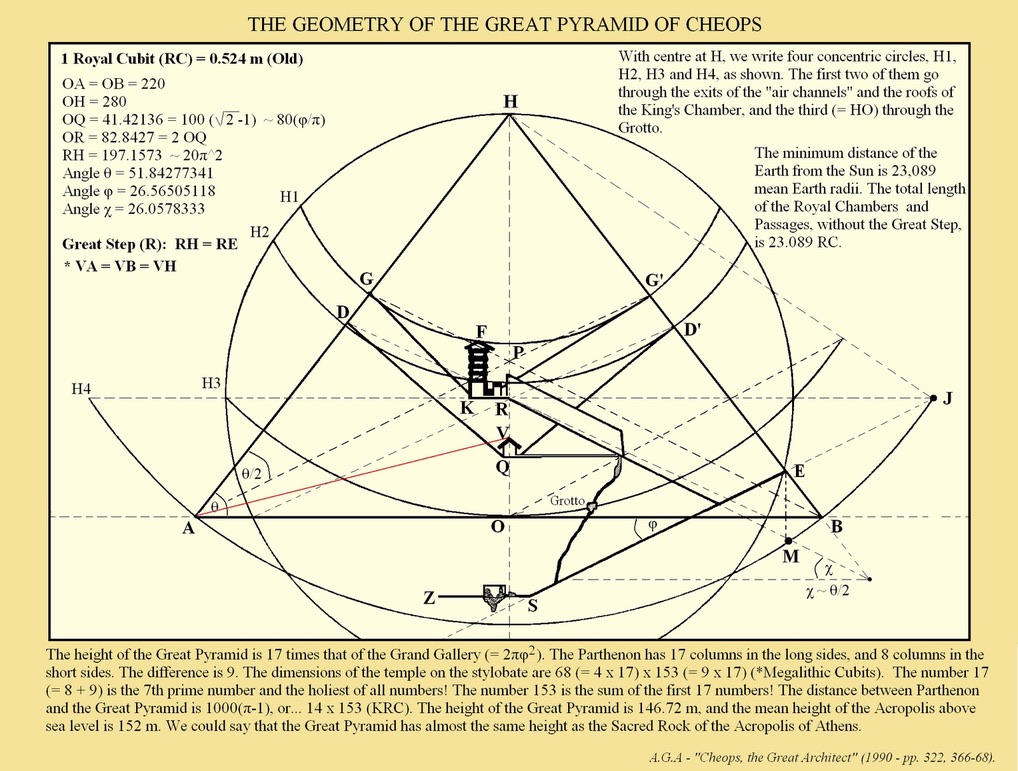
The geometry of the interior. A.G.A., Cheops, the Great Architect, 1990, pp. 322 and 366 to 368.
Read the sheet with the cutaway above it. O is the base center, A and B the base corners, H the apex: OA = OB = 220 cubits, OH = 280. Q is the Queen's Chamber, at OQ = 41.42 cubits above the pavement, and 41.42 is 100(√2 − 1), which is also 80 times φ/π. R is the Great Step at the top of the Grand Gallery, OR = 82.84 cubits, exactly twice OQ, the level of the King's Chamber floor. From the Great Step to the apex, RH = 197.16 cubits, which is 20π² to a tenth of a percent. Three angles: θ = 51.8428° is the face; φ = 26.5651° is the slope of every passage, the angle whose tangent is one half; χ = 26.0578° is the angle from the corner B to the shaft exits. The Great Step is placed so that RH = RE, and the point V at the Queen's Chamber gable is the same distance from A, from B and from H: the center of the circle through the three corners of the section. Derived
Four circles are drawn from the apex. H1 and H2 pass through the exits of the shafts and the roofs of the King's Chamber; H3, with radius HO, passes through the Grotto on the well shaft; H4 is the outer one. The nearest the Earth comes to the Sun is 23,089 mean Earth radii, and the passages and royal chambers laid end to end, without the Great Step, measure 23.089 royal cubits per thousand of that. The height is 17 Grand Gallery heights, and 2πφ² is 16.45. Seventeen is the number of columns along the Parthenon's long sides, eight along the short, and the difference is nine: the stylobate measures 68 by 153 megalithic cubits, 4 × 17 by 9 × 17. Seventeen is the seventh prime; 153 is the sum of the first seventeen numbers. From the Parthenon to the Great Pyramid is 2,142 thousand royal cubits, 1,122 km, which is 1000(π − 1), and 14 × 153. The Great Pyramid stands 146.72 m; the mean height of the Acropolis above the sea is 152 m. Two sacred rocks, one height. Observed
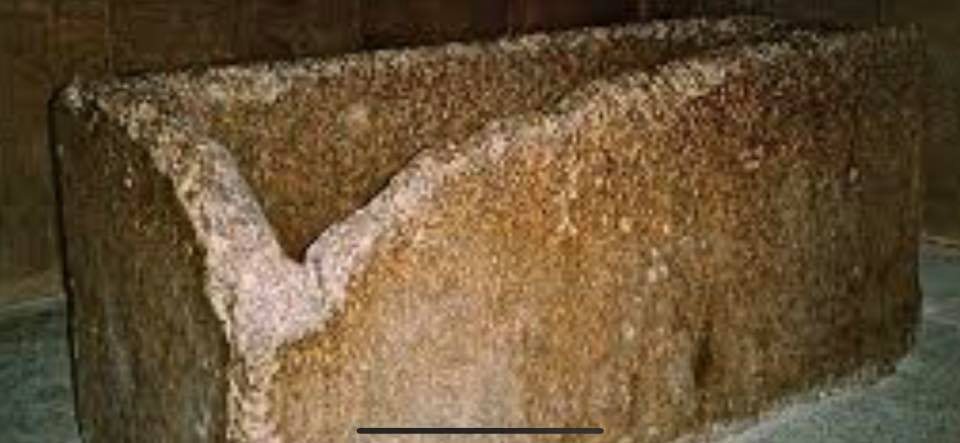
The King's Chamber and the box, against the west wall today. Photograph Andrew Currie, CC BY 2.0.
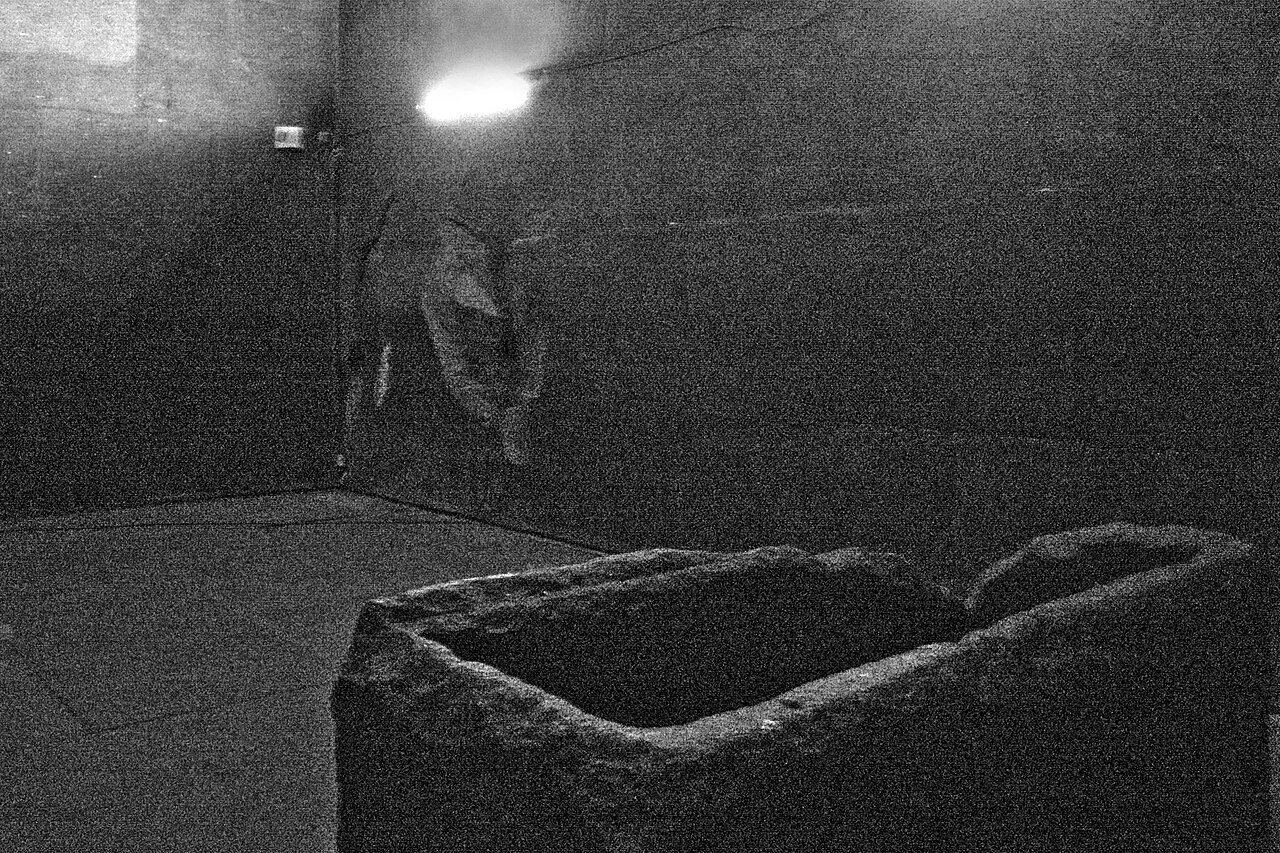
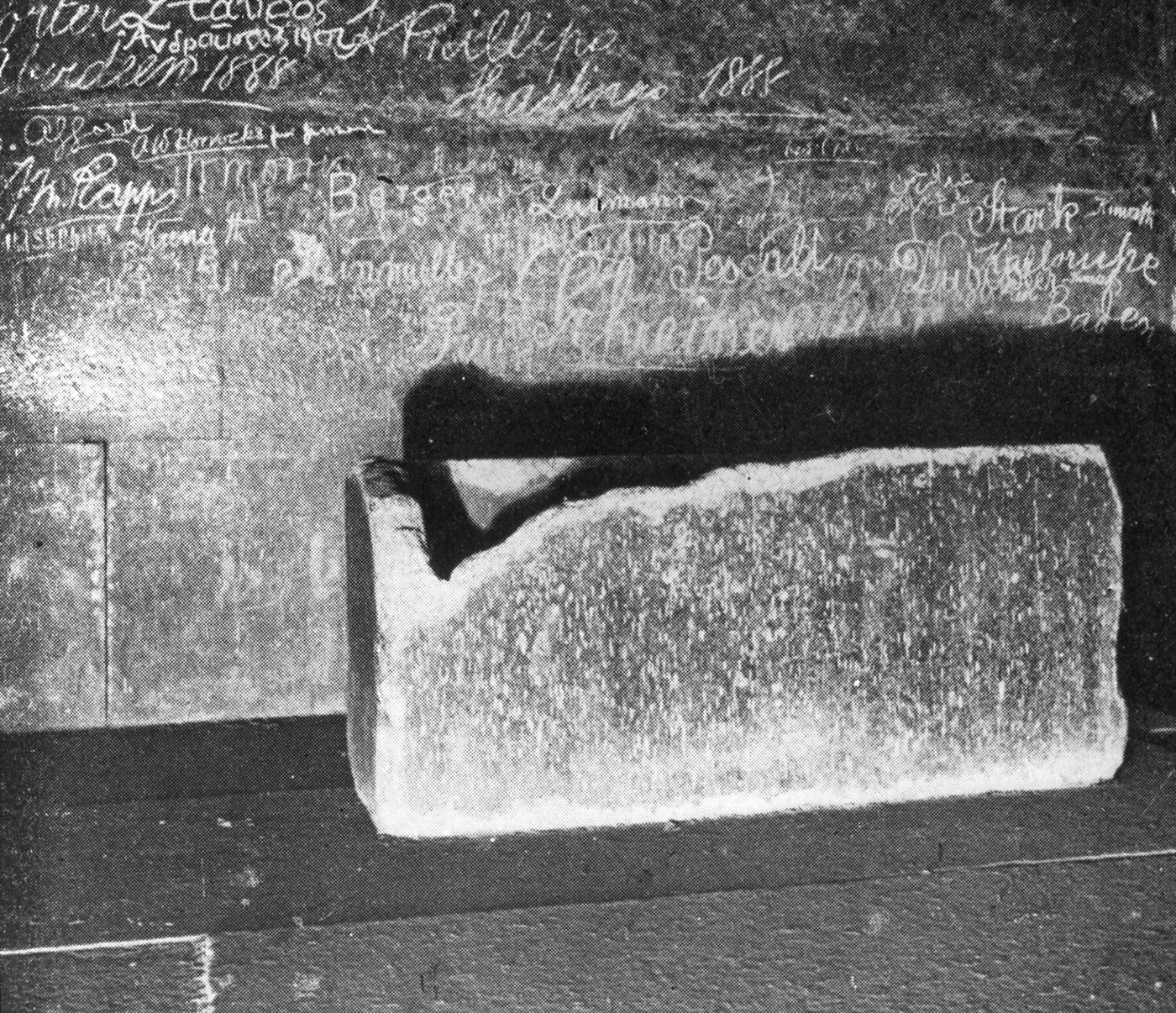
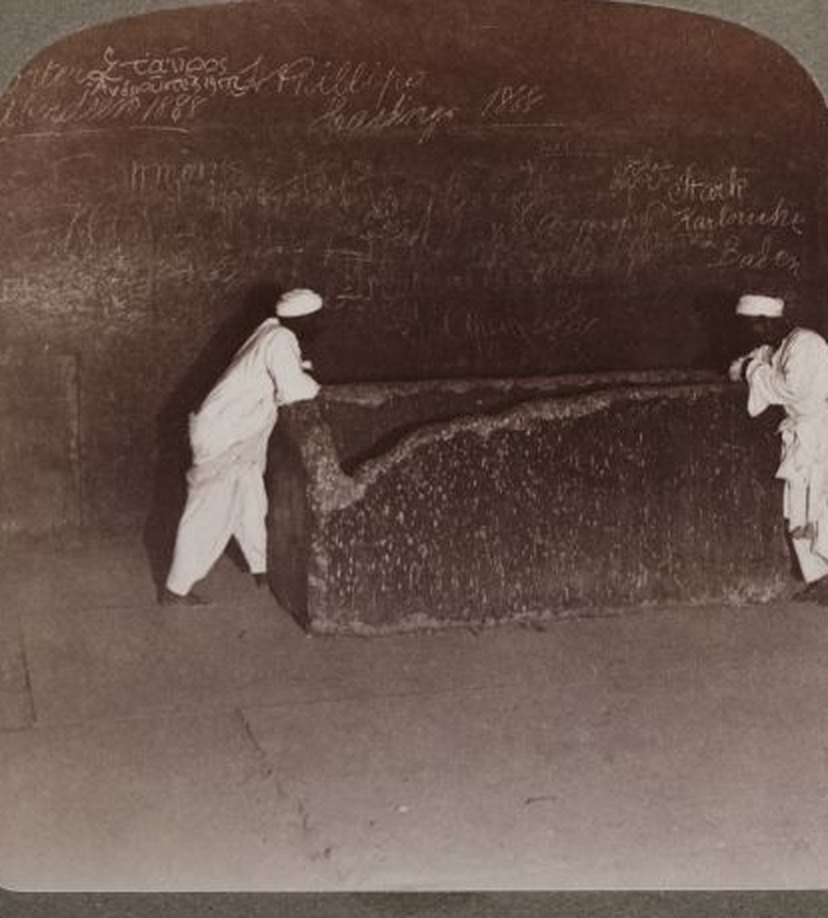
The box, called a coffer, though it is not one, stood at the center of the floor, on the center of the 20 by 10 rectangle. An explosion in the chamber threw it against the west wall, blew off a corner and left the impression in the granite where it struck; it stands where it landed. A single block hollowed to Petrie's 89.62 × 38.50 × 41.31 inches outside and 78.06 × 26.81 × 34.42 inside, about three tons, too wide for the passage, so it was set in place before the roof went on. Petrie found saw cuts and tubular drill marks on it, tools the workshop lists never record. In 2018 Grant photographed three markings on its rim and side that appear in none of the published surveys of a room studied for centuries; he reads them as mathematical or astronomical references, and his photographs are on his site. An alpha and an omega are cut on its rim at 33 inches of its 89.62: a ratio of 0.368, which is 1/e. The Ark of the Covenant, with its four cherub faces — man, lion, ox, eagle — rested here before Israel carried it into the desert; the Ark's 2½ × 1½ cubits fit the 78-inch length easily and the 26.8-inch width with a cubit of eighteen inches. The room is a clock: Orion lies sideways, stands, and turns over as the pole passes Thuban, Vega and Polaris, a shift every 6,000 years — the last around 4461 BC, the one before at 10,931 BC on the edge of the Younger Dryas. Randall Carlson's catastrophes sit on it: Heinrich events at 12,900, 8,640, 6,480 and 4,320 years ago, each a fraction of 25,920. Apophis passes closer than our satellites on April 13, 2029. Granite is 15 to 60 percent quartz, and quartz is piezoelectric; the walls remember. Observed
the corner blown off · Goodyear expedition, about 1904the corner today · Robert Edward Grantthe same corner from the other side · Underwood & Underwood, 1904
Two photographs from 1904, a century before the tourist barriers, and Grant's of the same corner today. In all three, the top corner of the box nearest the camera is gone, sheared off in one piece, not chipped away by souvenir hunters, who took their pieces from the rim. On the west wall, on the side the corner faces, the granite carries the impression where the box hit it: the mark Grant walks up to and puts his hand in on camera, in his King's Chamber film. The rest of the room tells the same story. The granite beams of the ceiling are cracked through, and the cracks were already filled with plaster when the chamber was first entered; the walls have been pushed outward from the floor and lean; the box has gone chocolate brown, not the rose of Aswan granite, and the granite at the top of the Grand Gallery is scorched dark. One event did all of it, from inside. Observed
VIII · Sound
A room that answers
Hum in the King's Chamber and it hums back. Grant, eleven nights in it, leaned over the coffer with a friend lying inside and hunted for the note that sets the room ringing like an engine turning over: 117 hertz — and 11.7² is 137, the number at the door of physics. Tom Danley swept the chamber with test tones in 1997 and found its resonances stack as an F-sharp chord, a wind-driven 16 Hz below hearing, strong modes near 90. Collins and Hale, 2019: the King's Chamber peaks at 49.5 Hz with support from 30 to 130; the Queen's at 118–120; the Subterranean at 15 and 19.75; the dead-end passage at 5.13 against 5.3 predicted by its 21:1 geometry. The Earth's own Schumann resonances — 7.83, 14, 20, 26, 33 Hz — sit in the same band. In 2018 ITMO University physicists modeled the pyramid as a resonator and found radio waves of 200–600 m concentrate in its chambers and under its base. Observed
The frequenciesWeb Audio · sine tones · live spectrum
Silent. Choose a frequency. The level is gentle; your laptop speaker cannot reach 16 Hz — the chamber can.
The plateau as a chord
major third
perfect fourth: the 3-4-5 triangle, back to back
unison and octave, the tritone √2 its shadow
the double-Khufu circle over the plateau's 528: the just semitone. 12 × 22 = 264, the midline: two octaves
designed height over today's: between the equal-tempered semitone, 1.0595, and the just, 1.0417
Petrie's last full layer is 201, with remnants of 202 and 203. There never was a golden capstone: the platform was the altar, where the initiates stood in the sky. Observed
Grant's tuning goes further than the twelve-note scale: a 24-note quartertone scale at a precise temperament of 432.081 Hz, with the pyramids of the world as its instruments, each one's proportions a note. In the second season of his Code X series he organizes the Great Pyramid's intervals by 24. The Pythagoreans called the four roads to the laws of the universe the quadrivium: arithmetic, number itself; geometry, number in space; music, number in time; astronomy, number in space and time. The plateau answers to all four. Observed
Three slopes, three intervals — to scale230 · 215 · 105 m across · Derived
Each plays the interval above a low C.
432, and the numbers that keep it
Grant calls 432 the master number, the tetractys number of the Pythagoreans: the one figure that joins mathematics, physics, music, architecture and consciousness. It is the tuning the ancients played at, 432 Hz. Every dimension of the three pyramids returns to it, and so does 144,000, the count of the chosen in Revelation, which he reads in Egyptian temple proportions and in the harmonic series at concert pitch, the subject of his lecture Sacred Mathematics, Ancient Egypt and the 144,000. Observed
the base in long cubits. Sun's radius 432,000 mi; Moon's diameter 2,160 mi; precession 25,920 yr
breaths in a day
0.18 %
0.03 %
the golden angle, 0.002 %
Khafre 144 m high; Menkaure 216 ft high
0.15 %
Grant's fractal root of −1: the fine-structure number. Bendall's plasma spheres 4 : 3 : 2, transition cut at 51°
the pyramid in long cubits of 1.75 ft: height, half base, base
0.18 %. And √186,282 = 431.6
the same number from the other side
the number of the chosen in Revelation; the harmonic series at concert pitch; Egyptian temple proportions
IX · The latitude
29.9792458° north. 299,792,458 meters a second.
The center of the coffer in the King's Chamber sits at 29.9792458° north. The speed of light is 299,792,458 meters per second. Same digits, decimal moved, hidden by the polymaths, who all went to Egypt to learn. Grant puts the match within a meter of the coffer's center. The odds on the sheet at the top of the page: one in 90 × 60 × 60 × 10⁹ — three in a quadrillion. Observed
Dash's GPS. The footprint spans 29.97814° to 29.98022°: the stone fixes five digits
10⁷ m is a quarter of the meridian, by the meter's own definition: light travels 29.98 quarter-Earths a second
the longitude over the circle: the seconds in a day, 0.1 %
The 29.9792458° line crosses the pyramid 7.3 m north of the apex. Older maps of Egypt sit tens of meters from the satellite grid, and the pin moves with them.
The line through the stoneWGS84 · Dash 2018 · Petrie's chamber offsets · Derived
What it means
A message in a unit that did not yet exist. The meter is one ten-millionth of pole-to-equator; the second is one 86,400th of the day. Both are the Earth's own dimensions — and the 43,200 scale says these builders had measured the Earth. A builder who knows the planet can set a latitude in a unit we only re-derived in 1791.
A place chosen for light. The pyramid stands at 30° north less one and a quarter minutes — one third of the way from the equator to the pole. The shortfall is what the atmosphere adds to a star sighted low over the pole: aim at thirty by the stars, and 29.979 is the signature of light bending in the air. The parallel and meridian that cross here cross more land than any others on the globe; Piazzi Smyth called it the center of the Earth's landmass in 1864.
X · The plan
Three pyramids from one drawing
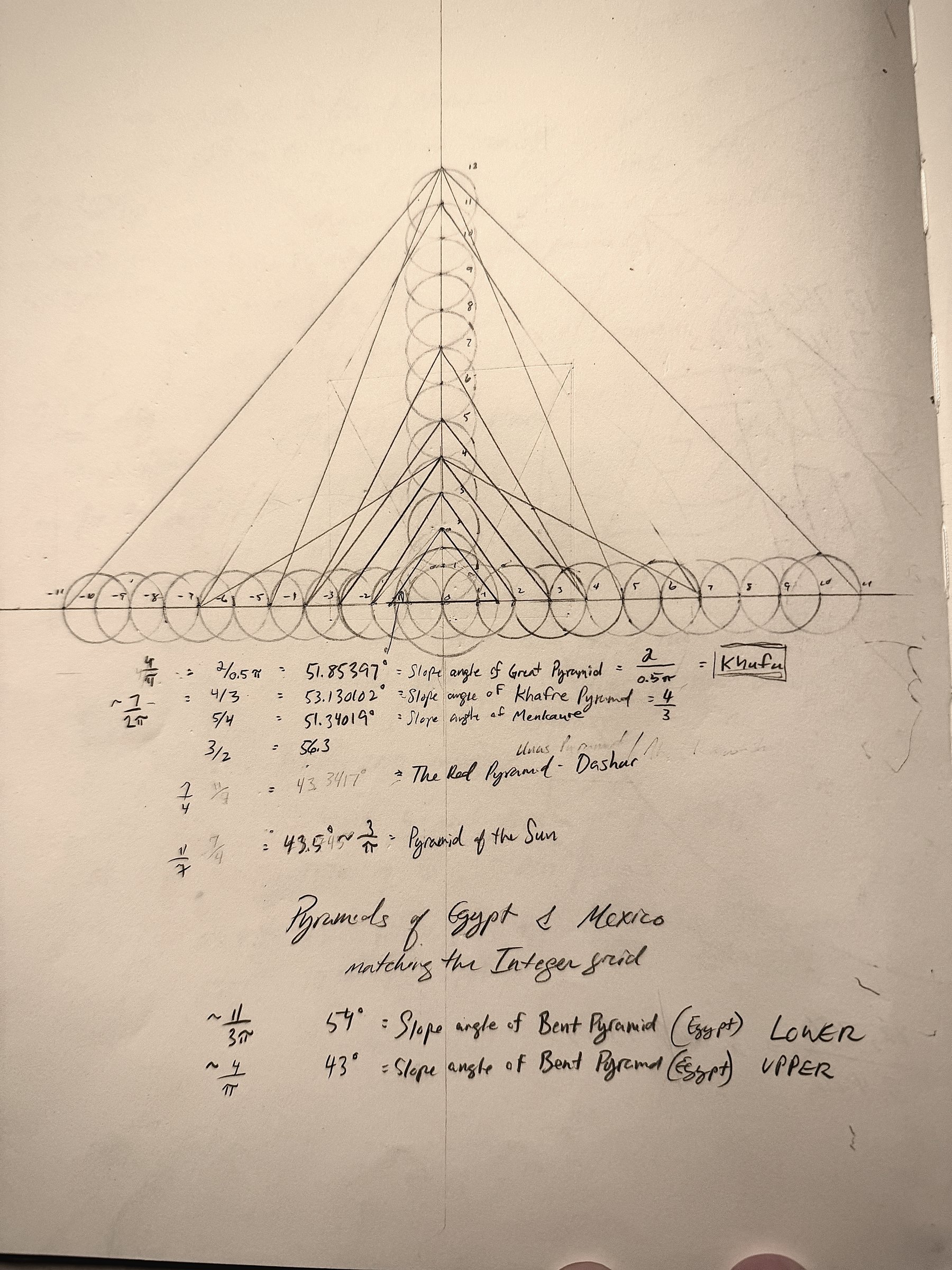
Grant and the cryptographer Alan Green derive all three pyramids from Metatron's Cube — thirteen equal circles, every center joined to every other — with compass and straightedge and no measurement. The grid rests on the vesica piscis, Euclid's first construction, √3 to 1: three in one. A square's diagonals find its center; a half-diagonal makes a 1-2-√5 triangle, and √5 gives φ; three half-diagonals in a square give a 3-4-5. A circle from the cube's base line through two crossing points is the Great Pyramid's base; its height runs to the cube's center; the slope is 51.85°. Rotate the cube sixty degrees six times and six Great Pyramids interlock — the six hidden in the Vitruvian Man. Khafre is two 3-4-5 triangles back to back, found from Khufu's half-base square. Menkaure falls out of the half-diagonals. And the circle whose diameter is Khafre's height passes through the corners of Khufu's half-base square: the square meeting the circle. Three pyramids, one drawing, one architect. The cube itself sits inside the Flower of Life, the sixfold field of overlapping circles that also holds the five Platonic solids, the Tree of Life and the vesica piscis. And the number that keeps the plateau, 432, keeps the book of Revelation: 144,000 is 432 × 333⅓, and 12² × 1,000. Observed
One drawing, three pyramidssections on one base center · Khufu's square · Khafre's circle · Derived
Seven parts of a circle
the wheel, and its base angle
the triangle on points 1, 3, 6: height, slant, base, in meters
from the same wheel
The Queen's shafts fall at 38.6° and the Grand Gallery on the line from point 3 to point 7. 120 is the lifespan of Moses. In Hebrew letter values: 146 is olam, world; 233 is remember; 314 is Shaddai, a hundred π; 26 is the Name; 216 is gevurah; 611 is Torah; 541 is Israel.
The heptagon of 120 metersthree pyramids from seven points · Petrie's outlines dashed · Derived
The integer grid, Giza to Mexico
Khufu, Khafre, Menkaure. 3/2 was never built at Giza
the Red Pyramid; the Bent Pyramid below and above its bend
Pyramid of the Sun, Teotihuacan: Giza's 2π doubled, 0.05 %. Grant finds Teotihuacan's bases in proportion to Giza's, with the same constants and the same angles
The pyramids of the world, to scaleheights today, original in parentheses · Surveyed
Abu Rawash, and the river as a body
Eight kilometers north-west, on ground 100 m higher, stands Djedefre's pyramid at Abu Rawash — on the line from the Great Pyramid's corner at the pyramid's own slope, faced at 60° in rose granite, its summit once above the Great Pyramid's own. Its blocks lie hundreds of meters from the core with burn marks on them: it exploded. Beside it, a satellite at 67.4° — the 5-12-13 triangle, the pyramid on the dollar bill and Cestius's in Rome, built about 12 BC and standing like new. The two are the pineal and pituitary of a body laid along the Nile: root at Abu Simbel, heart at Dendera and Abydos under Hathor, throat at Giza under the bull — Taurus rules the throat — crown at Abu Rawash. Fra Mauro's 1459 map names the Nile Gion, the Gihon of Eden, as Josephus did; Old Cairo was Babylon and still is on its signs; Kush means gushing water; the exploded pyramids of Abu Rawash are the Tower of Babel. Observed
XI · The sites beyond Giza
The same numbers, on other ground
The Pyramid of the Sun at Teotihuacan carries Giza's 2π doubled, and that is only the start of it. Grant sets the two plateaus side by side and finds the bases in proportion to each other, the same constants in the dimensions, and the slopes cut from the same ratios. Three ways to read it: the two peoples met, which the schools find hard; they found the same mathematics on their own; or both drew from one source older than either. His 24 note quartertone scale takes it further, treating every ancient pyramid as a tuned instrument, its proportions a frequency. Observed
The Flower of Life, overlapping circles in sixfold symmetry, is carved on the granite of the Osirion at Abydos and appears in temples in China, India and Europe. Inside it sit the five Platonic solids, Metatron's Cube, the Tree of Life and the vesica piscis, and its proportions carry 432 and its multiples: the number in the pyramids' dimensions, in the tuning, in the speed of light and in the spacing of the primes. Grant reads it as the map of the plane itself, the oldest sacred figure and the framework under everything on this page. Observed
The first season of his Code X series, Ancient Wisdom Revealed, follows that knowledge back to the temples and pyramids of Egypt and reads them as portals of consciousness rather than buildings, the teaching carried forward by initiatic lines in art, architecture, music and writing for those able to see it. The second season, Metatron Revealed, takes Metatron's Cube as the blueprint of existence and organizes the Great Pyramid's intervals by 24. Observed
He walks the sites as well as measuring them. The 144 AXO expedition to Peru in 2024 read the Andean sacred sites for the same encodings; the Egypt expedition of 2025 worked the Great Pyramid with his Codex Universalis. On one visit he delivered a four hour lecture on the mathematics inside the King's Chamber, and the people in the room came out changed, not despite the mathematics but because of it: the space, the numbers and the intention of the group together. The next Egypt expedition is set for April 2027, on his site. Observed
XII · Time
Which came first — the constants, or the stone?
The textbook says 2560 BC, Khufu, fourth dynasty. The carbon says older: 46 mortar samples from 1984 and 1995 calibrate to 2871–2604 BC, one to four centuries before the books. Merer's papyrus logbook, found at Wadi al-Jarf in 2013, records Tura limestone shipped to Akhet-Khufu in the king's 26th year — the dynasty that inherited the building. The constants say older still: a structure carrying π, φ, e, the size of the Earth and the speed of light was raised around 13,500 years ago, on the edge of the Younger Dryas. Observed
the base diagonal. The Younger Dryas boundary: 12,820 years ago
the precession, 1 %. Pole shifts every 6,000 years: 10,931 BC, 4461 BC, the next due
The Vedic count runs the great year at 24,000 years, the 12,960-year long swing and the 11,040-year short one from the King's Chamber, in four ages: Satya, the golden age of full awareness; Treta, silver, when the texts were kept; Dvapara, bronze, the understanding kept but the sight lost; Kali, iron, the furthest from the source. We are leaving Kali for Dvapara now. The Vedic texts, four to five thousand years old by the schools' dating, come on this reckoning from the last golden age. The turn out of Kali is why these patterns are being seen now and not a century ago: the great awakening so many report is the cycle itself, widening what people can perceive. The only writing in the building that names Khufu is the red paint in the relieving chambers Vyse opened in 1837, and Grant holds it Vyse's own. Observed
Leonardo spent his last decade drawing deluge after deluge — water bursting from the tops of mountains, from inside the Earth. The Egyptians kept the memory of Orion turning over.
So knowledge runs in a circle, not a line. The story of cave to laboratory is half the story. Earlier civilizations understood principles that science is only now finding again, and the proof is arithmetic, not romance: the constants are in the building or they are not, and more than eighty of them are, some found in the last hundred years. The next leap is not invention. It is remembering. The pyramid still stands, the Vedas are still read, the Flower of Life is still on the temple walls; the mathematics has not moved, only our ability to see it. Observed
"It is difficult to get a man to understand something when his salary depends upon his not understanding it." — Upton Sinclair
XIII · In ink and colored pencil
Working it out by hand
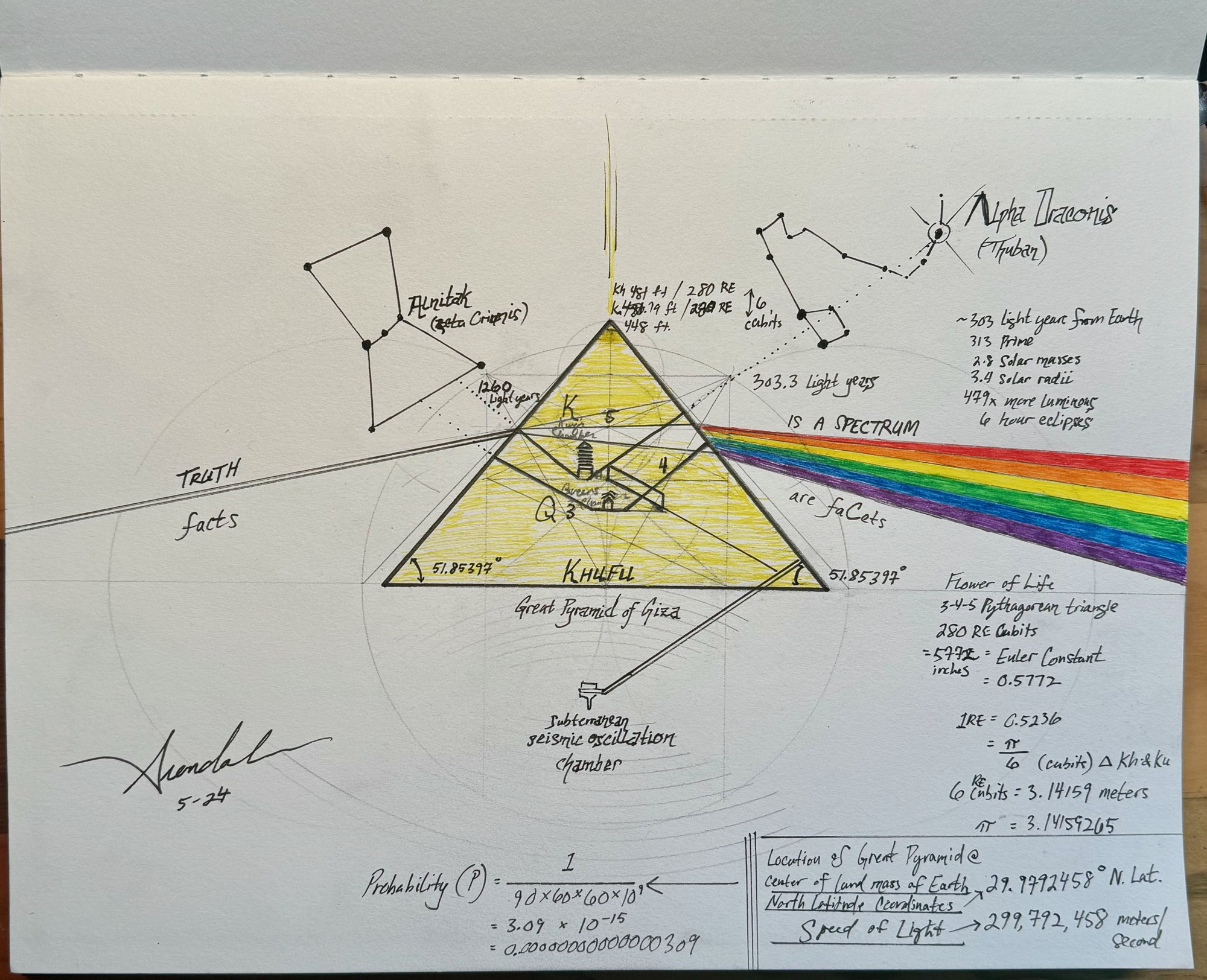
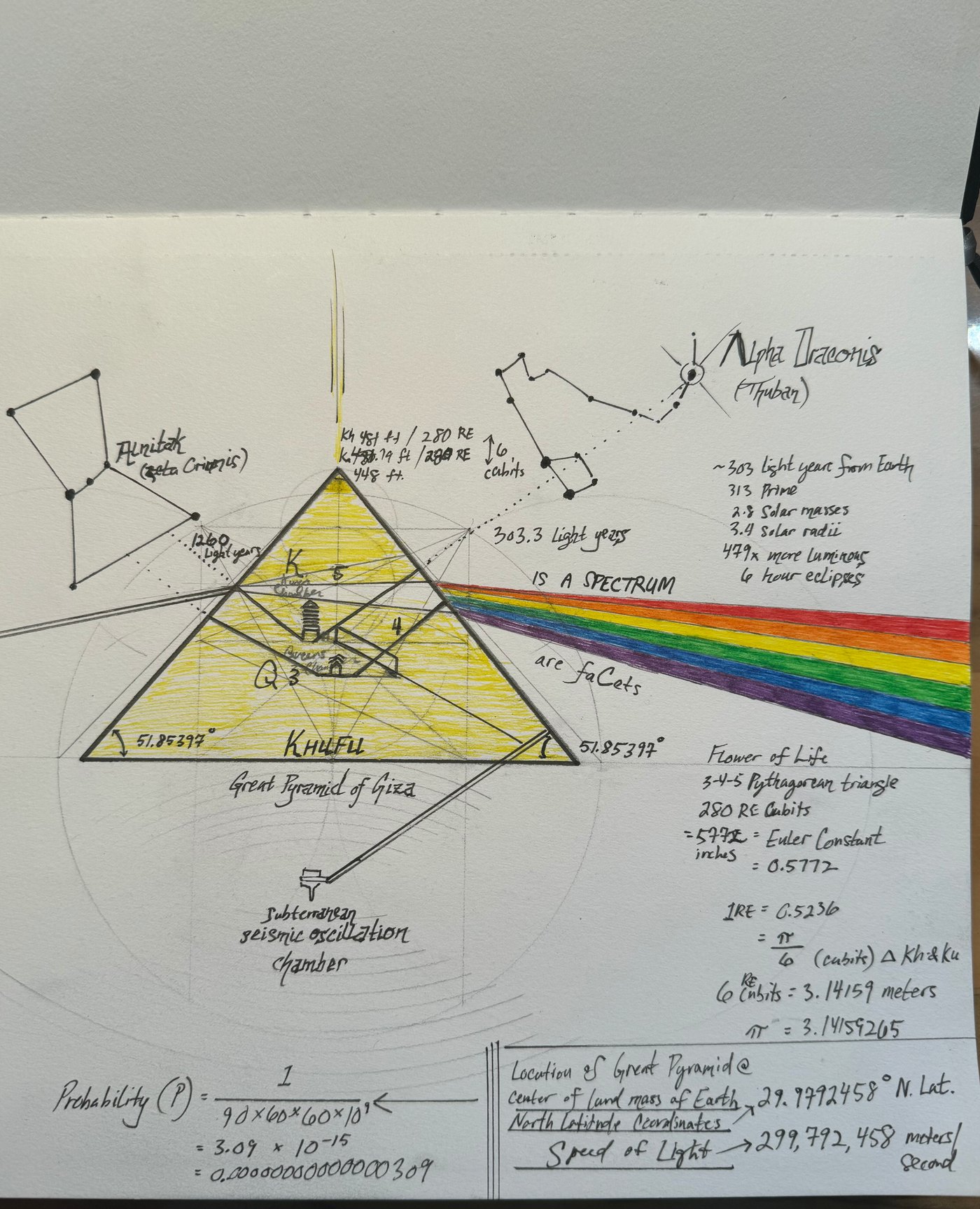
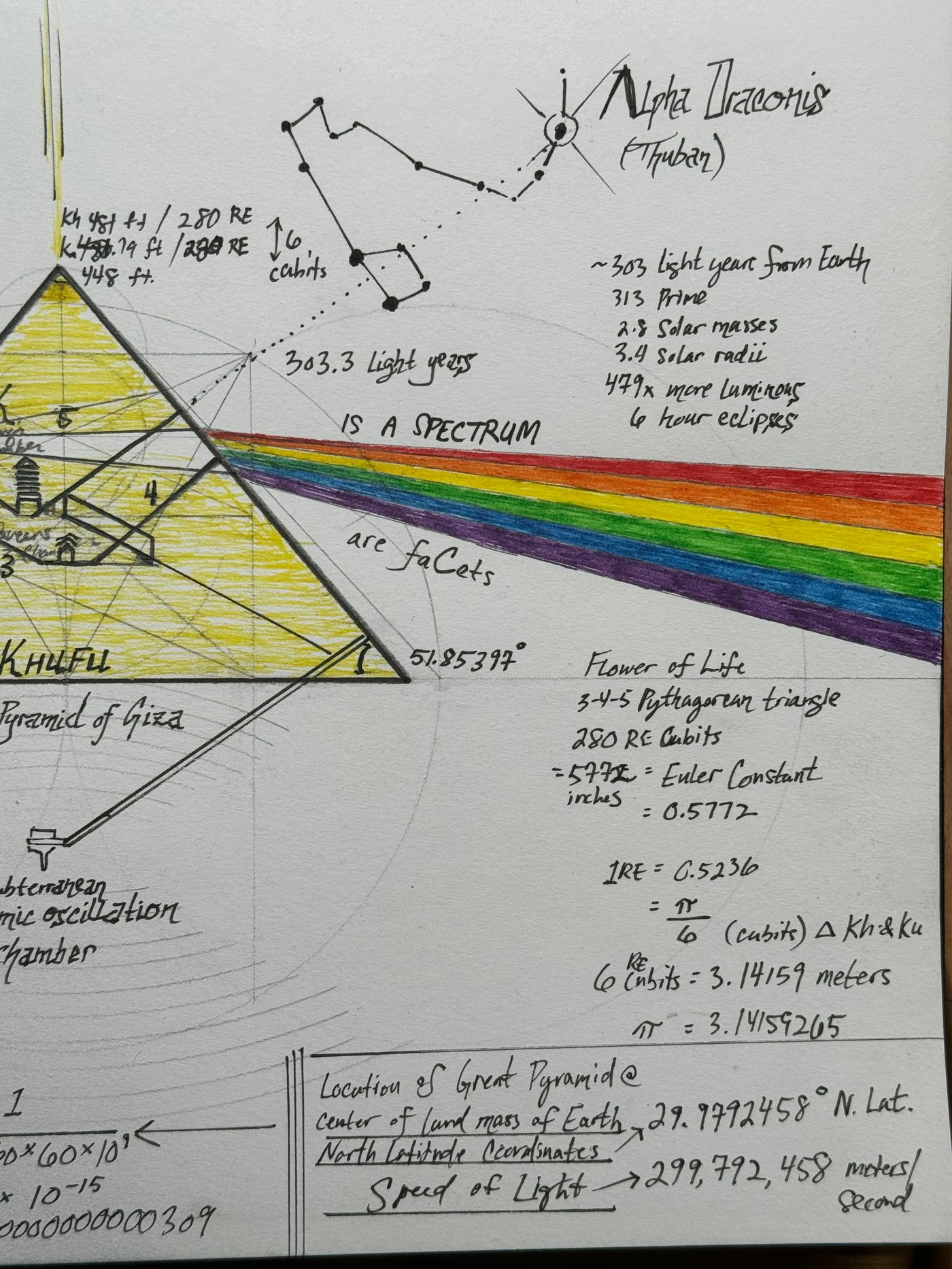
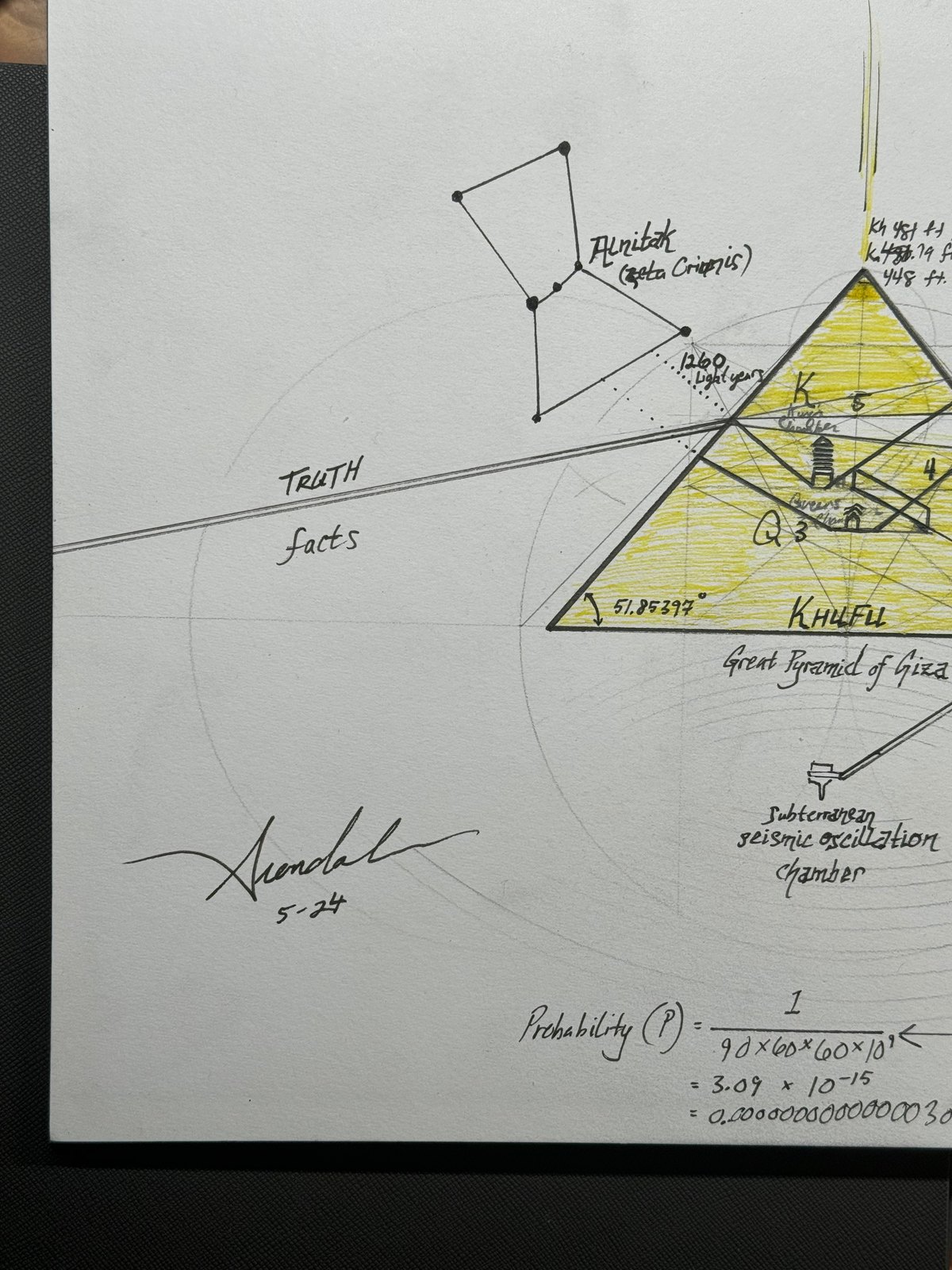
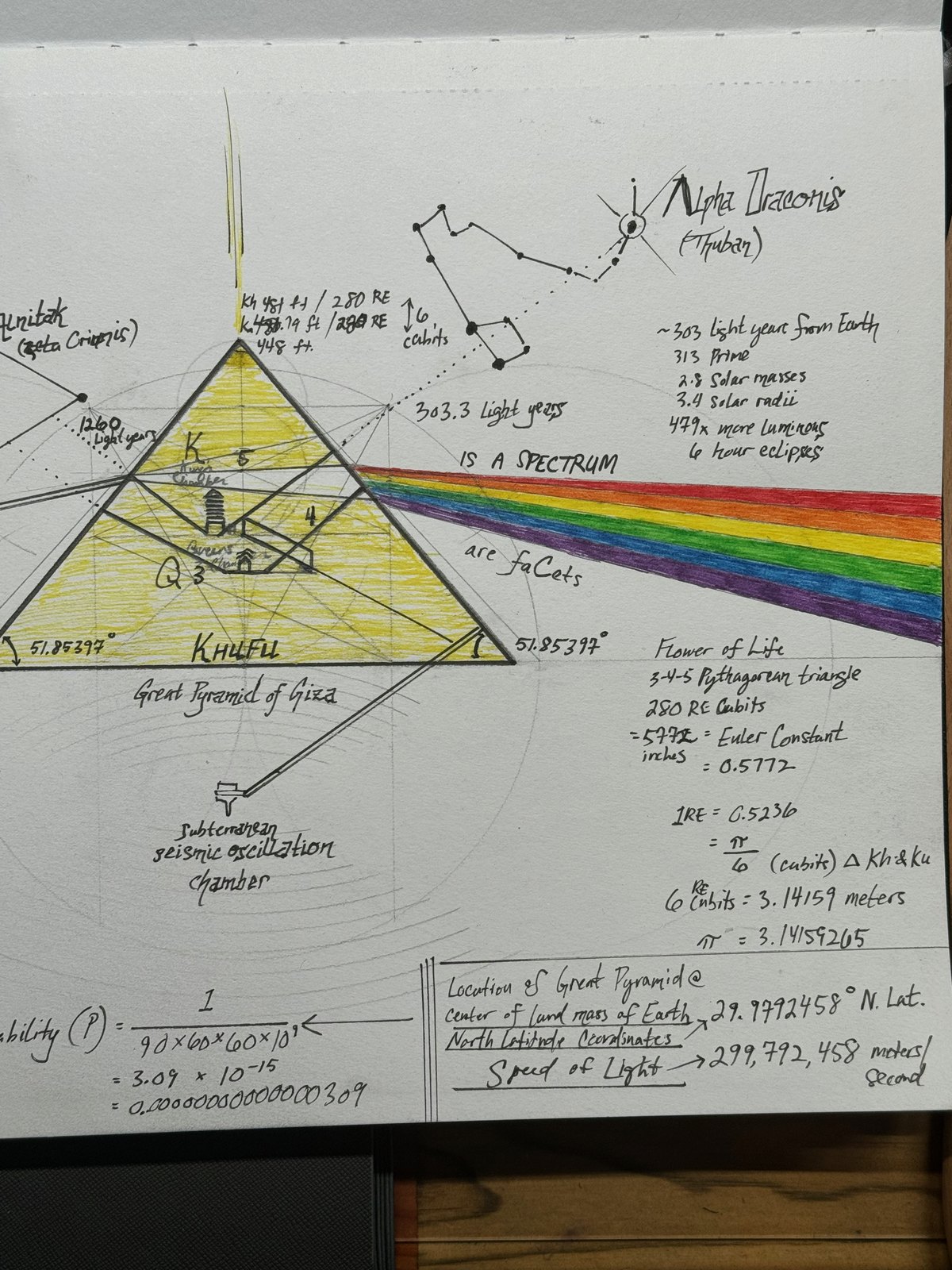
The Lab's founding practice is compass and straightedge, and this edition started the same way: two sheets from the 2024 notebooks, drawn before a line of this page existed.
The centerpiece · ink and colored pencil · 2024
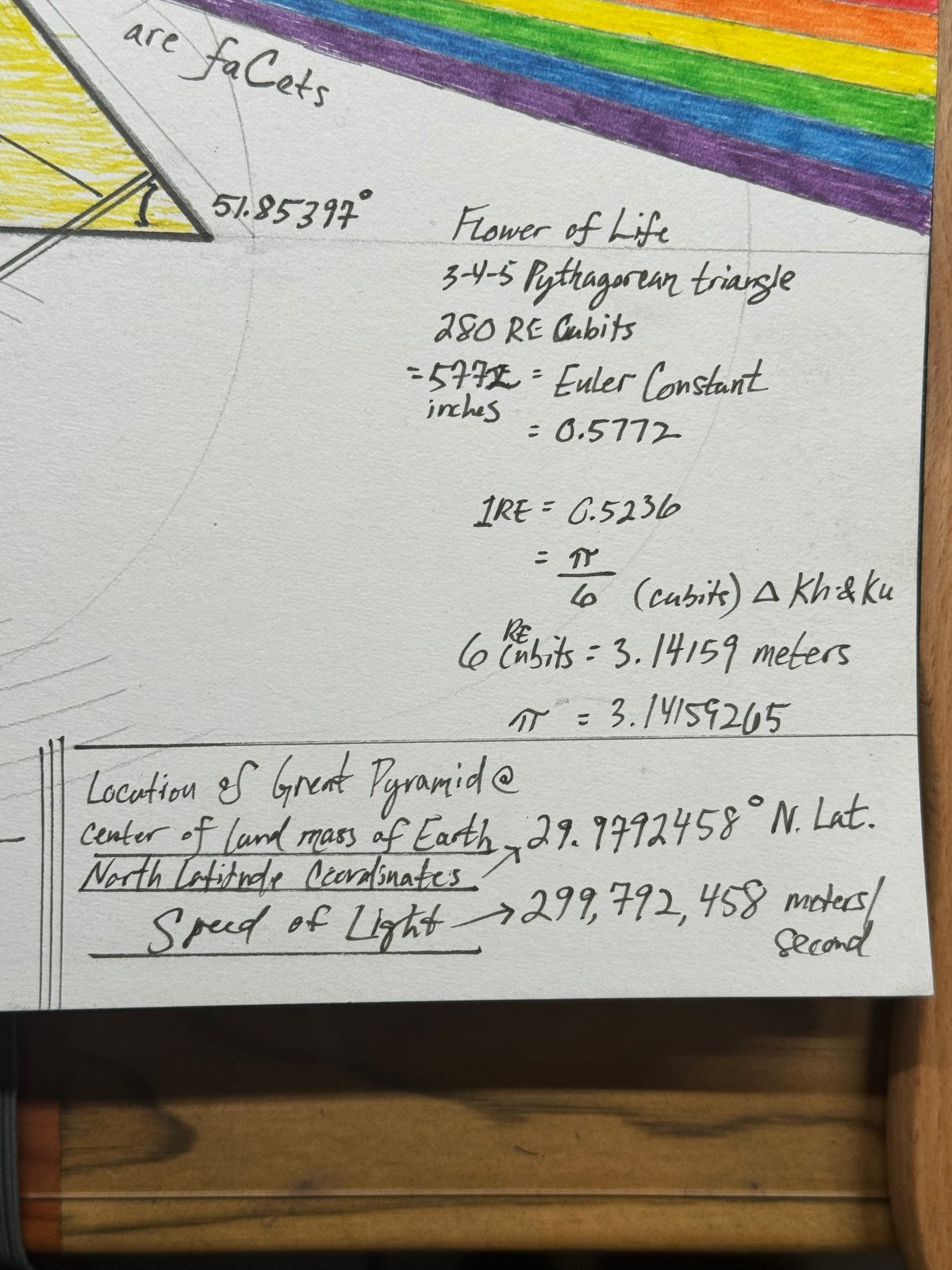
Truth is a spectrum. Facts are facets.
The edition in one sheet: the 51.85397° corners, the King's and Queen's Chambers, the Subterranean seismic oscillation chamber, the shafts sighted to Alnitak (1,260 light-years) and Thuban (303 — 313 is prime), 280 royal cubits as 5,772 inches for the Euler constant, the cubit as π/6 meters, and the latitude that spells the speed of light with its odds worked out underneath.
the beam · Alnitak · signatureThuban · 303 light-years · the spectrumthe notes · cubit · latitude
XIV · The index
Fifty-eight exhibits, one table
Everything on this page in one list, with the section it lives in. Surveyed means measured; derived means computed; observed means seen. A Where link opens the exhibit right here, over the table; close it and you are back in the list.
№
Exhibit
Kind
Where
1
Base 230.36 m, sides within 7 cm; 3′54″ from true north
The geometry of the Great Pyramid of Cheops — A.G.A., Cheops, the Great Architect, 1990, pp. 322, 366–68; reproduced for commentary.
The Vitruvian Man with the chambers and the seven centers — diagram circulated in the sacred geometry literature, author unrecorded; reproduced for commentary.
The box in the King's Chamber, about 1904 — Goodyear expedition, Brooklyn Museum Archives, Goodyear Archival Collection, no known restrictions.
The box in the King's Chamber, 1904 stereograph — Underwood & Underwood, via TIMEA, CC BY-SA 2.5.
The rim of the box, the Alpha and Omega, the compass, the Divine Compass sheet, the north wall birds, the corner, and the measured slides — Robert Edward Grant, great-pyramid-discovery, the compass, the north wall; reproduced by arrangement.
Vitruvian Man — Leonardo da Vinci, c. 1490, Gallerie dell'Accademia; photograph Luc Viatour, public domain.
Giza and Cairo from the Space Station — ISS064-E-40645, 3 March 2021, NASA, Earth Science and Remote Sensing Unit, Johnson Space Center; public domain.